En español, en français, em português.
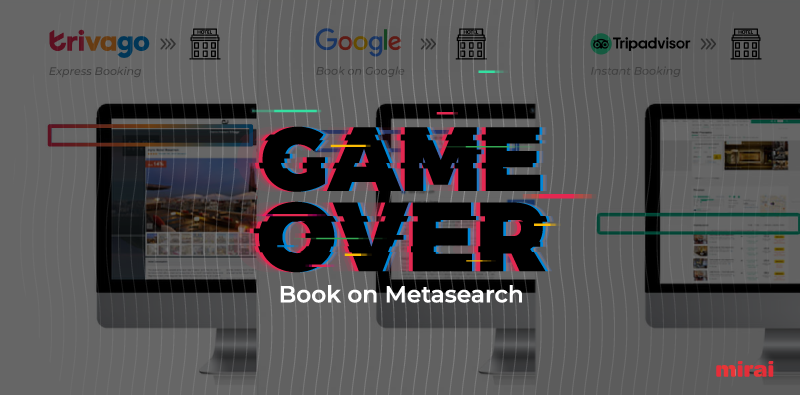
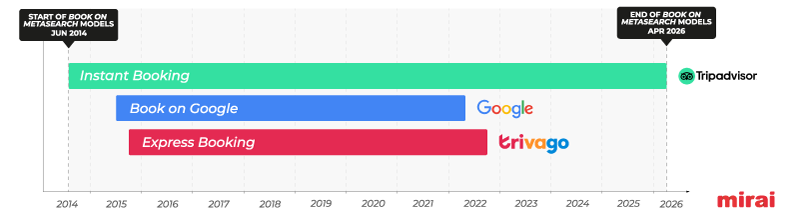
What began as the great revolution in hotel distribution a decade ago is now coming to an end. With the announcement of the closure of Tripadvisor Instant Booking (30 April 2026), the era of “Book on Metasearch” models is officially over. The “magic click” that was supposed to unseat OTAs has ended up quietly disappearing.
Chronology of a cycle coming to a close
The rise and fall of “Book on Metasearch” has been a learning process for the entire industry. Here is how the three giants attempted -and eventually abandoned- the transactional model:
What exactly were “Book on Metasearch” models?
To understand why they have disappeared, we must first remember what they promised. “Book on Metasearch” models (such as Book on Google, Tripadvisor Instant Booking or trivago Express Booking) were booking interfaces integrated directly into the metasearch engine.
Their main objective was to allow the user to complete their booking without leaving the platform. Although the inventory, price and final responsibility for the stay lay with the hotel or the OTA, the user experience (the look & feel) belonged to the metasearch engine.
Why did these models fail to succeed?
We can conclude that their decline was not due to a single factor, but rather a combination of operational, strategic and trust barriers. These are the main reasons:
- Lack of adoption: many hotels never felt comfortable “hiding” their brand behind the meta-interface, and OTAs did not want to feed a competitor that was trying to look too much like them. By not having the support of all connectivity partners and seeing how OTAs gradually withdrew, the model lost the critical mass and profitability necessary to sustain itself.
- “Merchant of Record” confusion: the user booked on the metasearch engine, but the charge was executed by the hotel or, occasionally, an OTA. This opacity generated critical insecurity: who to claim from if the room was not ready? Who issued the invoice? This lack of clarity regarding the real seller broke the basic pillar of any transaction: trust.
- The failed conversion promise: it was projected that removing the friction of jumping to the hotel website would skyrocket conversion, especially on mobile. It was believed that the “security” of brands like Google or Tripadvisor would provide peace of mind to the user, but the reality was the opposite: the process generated more confusion than fluidity.
- The official website won the technical race: the promise of “better mobile conversion” from metas vanished when hotel websites became fast, secure and optimised. The intermediary stopped adding technical value.
- Rate inflexibility and technological limitations: while direct sales evolved towards personalisation through member prices, dynamic packaging and added values, “Book on Metasearch” models presented a rigid structure. Unlike hotel booking engines, which have decades of development to manage the operational complexity of the sector, metasearch engine systems lacked the sophistication necessary to replicate these commercial strategies, limiting the hotel’s conversion capacity.
- Confidence in the custody of payment data: although brands like Google or Tripadvisor are tech giants, travellers became more cautious about sharing sensitive data on a “bridge” interface. The perception of risk increases when the user is not clear about who stores their card or under which security protocols the payment is processed. In the end, the customer prefers to enter their details on the hotel’s official source or with a recognised OTA, where the chain of responsibility is direct and the payment environment is clearly identified with the brand providing the service.
Is Agentic Booking “Book on Metasearch” 2.0?
Today we are witnessing an attempt to revive off-site booking through Agentic AI. The promise is similar: “book right here, without browsing”. The big difference is that AI is not a static interface, but a contextual assistant. Even so, it must overcome the same trust barriers that sank metasearch engines.
Comparison: Book on Metasearch vs. Agentic Booking
| Feature | Book on Metasearch | Agentic AI |
| Interface | Rigid and static form. | Conversational and contextual. |
| Branding and trust | Users did not know who they were buying from (confusing Merchant of Record). | AI can identify and connect with the official source from the start and be transparent about the source. However, it can also create confusion. |
| Added value | Only facilitated the checkout (data gateway). | Real assistant, resolves doubts and personalises the proposal. |
| Flexibility | Incapable of showing loyalty or complex offers. | Full access to the hotel’s pricing ecosystem (e.g. via MCP). |
| User role | Manual: the user had to fill in the data. | Delegation: the user asks the AI to execute the task for them. |
| Payment gateway | User distrust in providing payment details. | Can generate distrust in providing payment details. |
But will AI achieve what metasearch engines could not? Only time will tell. For now, history has taught us that the success of a technology in distribution does not only depend on its ability to simplify the process, but on not sacrificing transparency, brand identity and, above all, traveller trust along the way. The great challenge for new intelligent agents will be to prove whether they can be a real bridge to direct sales, or if they will end up stumbling over the same barriers that marked the end of an era for metasearch engines. The debate is open.