En español, en francés, en portugués.
Are we using AI correctly on the major ad platforms? We will explain how Google Ads, Meta Ads, Bing Ads, TikTok Ads and metasearch engines have been incorporating algorithms into your strategy for years, the unique value each one brings, and the most disruptive changes yet to come.
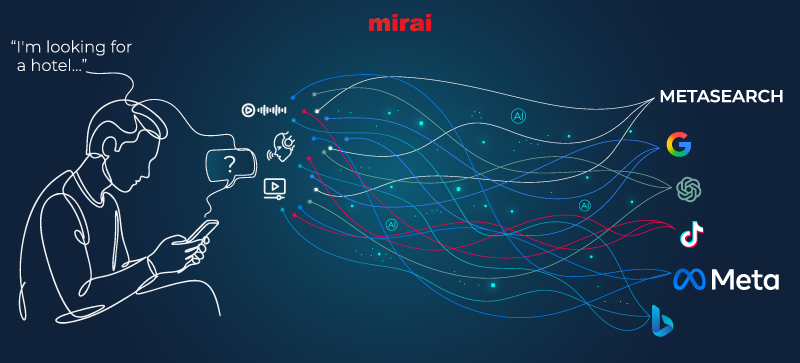
The paradigm shift brought about by AI and the recent emergence of ads on ChatGPT have forced digital marketing platforms to grit their teeth and evolve at breakneck speed. In reality, they have been pushing marketing teams to use algorithms for years, but now the transformation is much more significant. On the one hand, this is due to the need to reach users who are communicating in a different way. On the other hand, it is about simplifying and optimizing the hotelier’s day-to-day management.
Do we know what each platform offers in this new ecosystem? Are we ready to incorporate AI into our hotel marketing strategy?
In this article, we will try to break down what the major advertising platforms have to offer.
The 5 keys to leveraging AI in hotel marketing
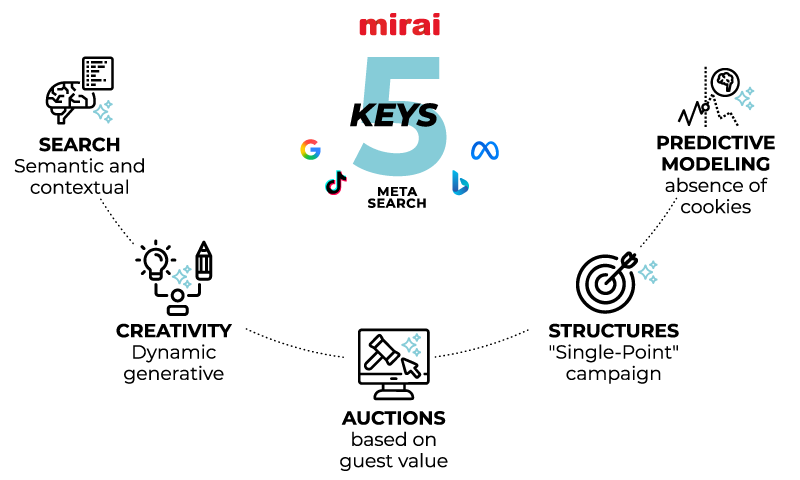
The changes that platforms have been introducing are closely interrelated. They aim to improve efficiency in terms of structure, management and budgeting. They also provide users with more tools to transform their interaction and communication with their audience. These are the 5 key points:
- Semantic and contextual search: ads are no longer triggered solely by keywords or narrow audiences, but by the intent behind the trip. If someone searches for “a family getaway”, AI understands that your city hotel is relevant even if they do not use the word “hotel”, and it can even take cancellation intent into account. Result: expansion of the qualified audience. This change means that you need to feed the algorithm quality data and give it time—and be patient—so it can understand users’ semantic context.
- Dynamic generative creativity: any ad campaign manager can edit—or at least customize and redefine—their own images and videos to fit the user’s profile. The immediate result is massive personalization at no cost and the creation of more asset versions to appeal to all kinds of interests.
- Smart Bidding 2.0: auctions based on guest value. In SEM, we are moving away from bidding for a cheap click to bidding on the expected value of the transaction. A user’s probability of booking is calculated based on intent signals, device, location and recurrence. If we feed the algorithm gross and net booking data, it will learn and make increasingly better choices. Result: easier achievement of goals and more efficient management of budget and time.
- “Single-Point” campaign structures: these platforms are eliminating the need to have 50 separate campaigns. Now, a single AI-powered campaign simultaneously manages discovery (social), consideration (video) and conversion (search). Key benefit: reducing human error and saving time and money.
- Conversion modeling in the absence of cookies. With privacy restrictions, platforms can no longer “track” everything. The AI solution is Predictive Modeling. If the platform loses track of a user, it uses patterns from millions of other travelers to “fill in the gaps” and attribute that booking to your ad with astonishing statistical accuracy.
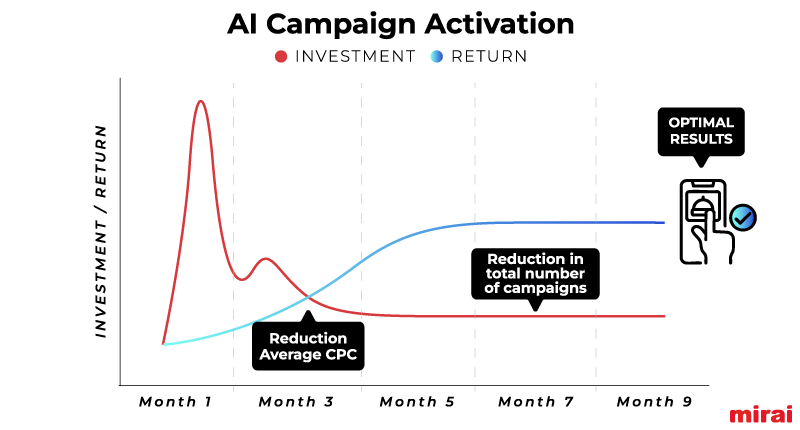
AI doesn’t mean spending more, it means simplifying
Does applying artificial intelligence mean more investment in our strategy? Launching new types of campaigns with a long learning phase requires, in principle, a significant investment compared to what is already in place. For example, Google suggests increasing budgets by at least 30% for Search campaigns with artificial intelligence (AI Max) to ensure the data volume that AI needs to learn.
However, it is not about spending more, but about simplifying to optimize. AI penalizes fragmentation (accounts with too many small, ineffective campaigns). By simplifying the structure and merging products (such as the future integration of Google Ads and Hotel Ads), we eliminate budget silos. In Social Ads, campaign structures have been completely overhauled to eliminate micro-strategies in favor of more efficient learning.
Furthermore, a great opportunity is emerging: according to Google, more than 15% of searches are completely new, and up to 70% consist of 5 or more keywords. This means that, because they are new, there is little competition for them, which significantly lowers the CPC. We are facing a unique opportunity to capture new, low-cost searches, and betting on traditional searches means paying more.
Cross-platform solutions like Claude are also emerging. Connected in real time to your booking data and campaign platforms, Claude acts as a “digital brain” or Brand Center, ensuring that every message, offer or response is flawless and personalized by customer and ad platform.
Conclusion: you need to run more expensive individual campaigns, but we are moving towards a scenario with fewer, smarter and better-synchronized campaigns. And if you also use a cross-platform solution, the overall budget is used more efficiently, reducing overlap and improving the final CPA.
The AI showcase of SEM platforms
Google Ads and Bing Ads, as key components of your hotel’s SEM strategy, are redefining themselves to respond to new search patterns. How are we evolving to run paid ads in conversational searches? And in agent-based searches?
Google Ads: from Search Engine to Predictive Ecosystem
Google has led the transition towards an efficient platform driven by artificial intelligence. We no longer buy keywords; we buy business results through hotel conversion goals. And AI (Gemini, in this case) serves as an intelligent layer that interprets the traveler’s intent from a multimodal perspective.
What AI features should we already be using in Google Ads?
- Smart Bidding is no longer focused solely on clicks, but on conversion value. AI analyzes thousands of variables to determine whether to bid on a user based on their real booking likelihood.
- Broad Match keywords are now the standard for removing the limitations of algorithmic learning. The algorithm relies on audience signals, takes user history into account to determine relevance, and displays results even when the search query does not exactly match the hotel’s name.
- Performance Max (PMAX) for Travel Goals Campaigns: campaigns that target generic searches (“family-friendly hotel in Madrid”) based on audience signals. AI acts as a unified inventory manager for creative and text assets, generating dynamic ads to impact each user according to their behavior on Search, Maps, YouTube and Gmail. Additionally, this campaign is linked to your hotel’s feed and therefore has centralized data, a key factor in future campaigns.
- Demand Gen for Travel: a campaign that displays static banners or videos and uses the hotel feed to reach audiences on YouTube or Discover. AI drives the omnichannel funnel: a single campaign can perform prospecting (searching for new guests similar to your customers) and remarketing (targeting users who have already visited your site) without the need to allocate separate budgets. It is also connected to your hotel’s feed.
What must we implement right now? The differential value: Search with AI Max
AI Max is the intelligence that captures conversational, voice or AI super-agent searches—in addition to traditional searches—while simultaneously generating and personalizing the content it delivers to you in the form of ads.
- Native presence in AI Overviews and AI Mode. Thanks to AI Max, the hotel appears in the search results alongside Google’s generative responses. Your hotel will be able to appear as a recommendation integrated into the response, but also as a native ad.
- Real-time intelligent asset generation. The AI scans the hotel’s website to draft titles and descriptions that match the user’s query. Furthermore, it aims for full synchronization with the feed to display real-time prices. Finally, the AI directs the user to the most convenient page based on their query or need.
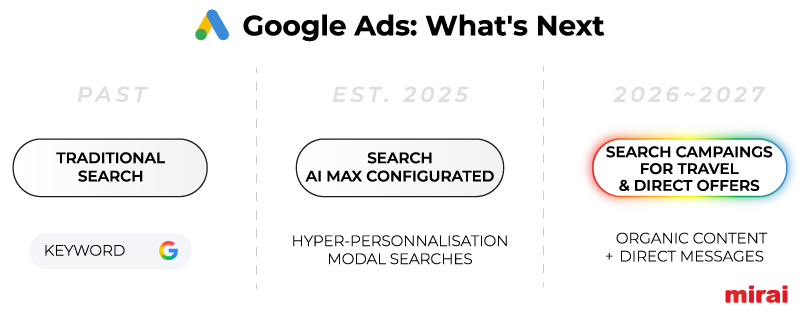
The most disruptive new feature: the new Search Campaign for Travel + Direct Offers
Google’s big promise is to one day merge Google Ads, Google Maps and Google Hotel Ads campaigns, and it has finally announced this with the new Search Campaign for Travel. This ultra-intelligent campaign will be an evolution of Search powered by AI Max, combining it with real-time data from your metasearch engine (prices/availability) and your location on Maps.
As they feature AI Max technology, the AI will dynamically generate ads in various formats that will display real-time prices and availability, while also drawing on the hotel’s photos and information.
In addition, this campaign impacts agentic searches searches with Gemini: since we are connecting Search to your enriched data feed for the first time, you are giving it access to key dynamic information. If a user asks Gemini, “Plan a trip to Barcelona with my partner—we want a charming, centrally located hotel with breakfast included for less than €200 per night”, the campaign analyzes that request, searches the inventory and serves the structured information to the AI in the form of an ad.
Search Campaigns for Travel will be launched by the end of the year (TBD) and will also include the Direct Offer option. It will be the generative equivalent of current ad extensions, but smarter: they are dynamic and personalized rather than static texts; native, as they integrate into the user experience as a useful action; and action-oriented at the bottom of the funnel.
These campaigns will be the way to reach audiences by paying LLMs or AI agents: on the one hand, you will have the organic content you display, and on the other, these additional messages. Organic and paid content will be synchronized because the hotel feed that Google Ads draws from will be connected to the dynamic data, the third layer of our AI infrastructure.
Bing Ads: the triumph of Copilot-Assisted Search
Microsoft leverages its ecosystem (Windows, Outlook, LinkedIn) to lead the way in attracting corporate and high-spending travelers. In 2026, ads will no longer be simple links, but rather recommendations integrated into productivity environments.
What AI features should we already be using in Bing Ads?
- Smart import from Google: automatically syncs and adapts your Google Ads campaigns to Microsoft, adjusting bids to match the more analytical behavior of the Bing user.
- Smart Bidding prioritizing desktop users: bid optimization focused on desktop and tablet users, who have higher conversion rates and longer session durations.
The differential value: Copilot Conversational Ads
This is where Microsoft leverages its partnership with OpenAI to transform how hoteliers engage with customers.
- Native chat recommendations: Copilot naturally integrates your hotel as a logical option within the written response to users planning a trip.
- AI-Generated Multimedia Ads: automatic generation of visual ads that adapt to the user’s operating system design (dark/light mode) to avoid being intrusive.
- Multi-signal intent analysis: ultra-precise segmentation by company, industry, or job title thanks to LinkedIn data, ideal for targeting event planners and corporate clients.
Conclusion
AI is undoubtedly the new standard in hotel SEM. Google Ads and Bing Ads demonstrate that success no longer depends on manually adjusting keywords and budgets, but rather on feeding and guiding the algorithm. Five key points:
- Real anticipation. Both platforms cross-reference signals from their ecosystems (maps, emails, calendars) to reach travelers during their predictable planning phase, before they search for the hotel.
- Native formats. Traditional ads are giving way to recommendations that are naturally integrated into smart chats (Gemini and Copilot) and creative content tailored to the user’s environment or AI agents.
- Quality data and simplification. AI rewards streamlined and optimized structure. The key is to feed the algorithm with first-party data to identify the highest-value guest and, at the same time, maintain a high-quality, centralized data feed—synchronized with our AI infrastructure—to fuel new campaigns.
- A larger budget in the short term, but potentially a smaller one in the long term. The opportunities (simplification, lower CPC) offered by the new smart campaigns offset the need for an initial budget.
- Plan to launch the new 100% AI-powered products. Surround yourself with experts who can help you develop a plan and guide you through the adoption of all the new smart SEM campaigns. There are many details and sudden changes, and it is essential to have a direct connection with Google and Bing.
Coming soon, we will show you the second part of the article, in which we will analyze how AI is revolutionizing Social Ads (Meta and TikTok) and Metasearch environments. We will wrap up with the definitive keys to an AI-based hotel marketing strategy.