En español, en français, em português.
The arrival of artificial intelligence is introducing three profound disruptions in hotel distribution and the direct channel:
- Conversational language. Many guests now prefer asking questions and receiving precise, multichannel answers instead of navigating long pages. Offering a fully conversational AI agent is increasingly important. Our AI agent Sarai meets this need.
- Visibility in AI assistants powered by LLMs. Unlike Google Search, LLMs such as GPT, Gemini and Perplexity have not published official criteria for appearing organically in their results. Concepts like GEO or AIO are often mentioned, but the reality is that there is no clear or scientific methodology—everything comes from experimentation.
- Official content and agentic capabilities. The strategic challenge for hotels is twofold: delivering official, verified and structured content to the AI assistants operating on these LLMs, and enabling agentic capabilities so assistants can take actions on behalf of the guest, such as completing a booking. Both objectives converge in a new component of the hotel tech stack: an MCP server.
Why LLMs now need structured and reliable data
Up to now, most content stored or learned by LLMs has come from large aggregators, forums such as Reddit, review sites like TripAdvisor or specialized media. While this information is rich, relatively up to date and useful in early funnel stages (inspiration, discovery), it presents three major issues:
- Uneven rigor. These are third-party sources, not official. The likelihood of inaccuracies is high.
- Lack of granularity. The further down the funnel a user is and the closer to booking, the more critical the level of detail and precision becomes. LLMs cannot afford to be wrong about policies, schedules, availability or services.
- Agentic risk. In scenarios where the LLM can perform actions on behalf of the user—checking availability, applying commercial rules, completing a booking—there is zero margin for error. A mistake at this stage directly threatens user trust.
OTAs can serve as a temporary patch, but they cannot guarantee 100% of a hotel’s real information. The only actor capable of speaking in the first person is the hotel itself. This is why hotel interests and AI assistant interests converge. MCP is precisely the protocol that enables this exchange.
What an MCP server is
When discussing AI, it helps to distinguish two layers:
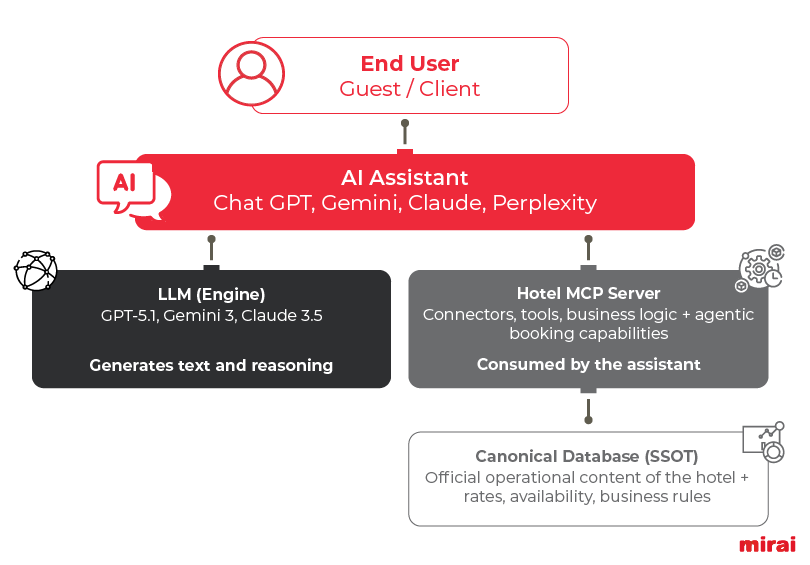
- An AI assistant (such as ChatGPT, Gemini or Claude) is the product the user interacts with: it manages the conversation, chooses which tools to use and shapes the final response.
- An LLM (Large Language Model) is the underlying engine (GPT-5.1, Gemini 3, Claude 4…), the mathematical model generating text and reasoning, but which on its own does not connect to external systems nor orchestrate anything.
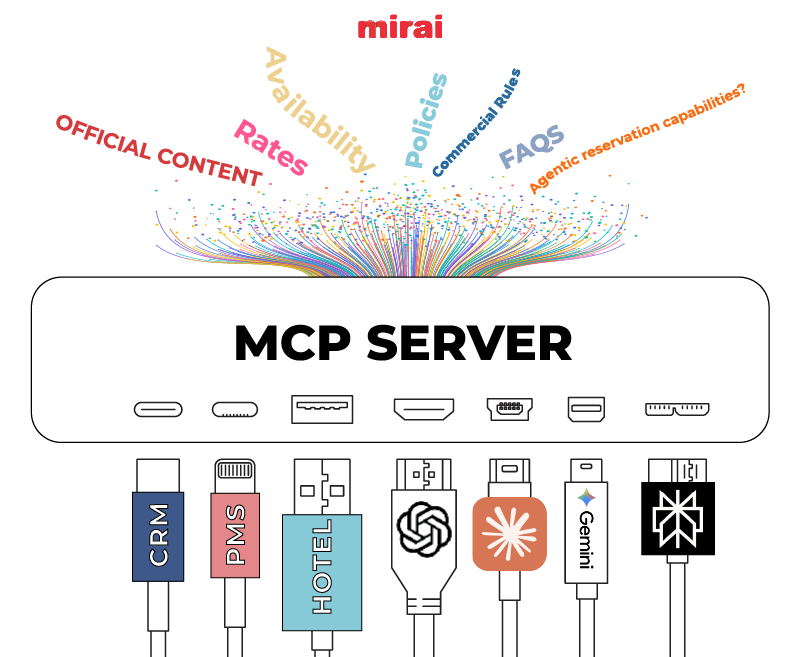
An MCP server (Model Context Protocol) is an interface that connects the hotel’s internal systems with AI assistants such as ChatGPT, Gemini, Claude or Perplexity. It provides hotel data in an orderly, structured and secure way: official content, rates, availability, policies, commercial rules, FAQs and, eventually, agentic reservation capabilities.
Although conceptually similar to an API, the key difference is that MCP functions as a universal standard —still consolidating— avoiding one-to-one integrations and acting like a “USB-C for AI.” It is the native way to connect with AI through its assistants.
Canonical database: ordered, accessible and structured data
Before thinking about MCP, hotels must solve a prior problem: disorder. Content is often scattered across websites, PDFs, internal documents, emails or even in employees’ memory. This generates errors, inconsistencies and unreliable answers.
The first step is to centralize all information into a canonical database—also known as a Single Source of Truth (SSOT)—a living repository that includes:
- Room types and real differences.
- Services, schedules, policies and restrictions.
- Detailed restaurant, spa, activities and kids club information.
- Guest FAQs.
- Relevant internal procedures.
- Destination information.
- Availability, rates, offers and commercial rules.
- Loyalty program benefits, levels and advantages.
A hotel will not have just one SSOT but several. Still, the content-and-reservations SSOT is the most critical and should be built first. This is the database that will feed the MCP.
Who should build an MCP
Building a solid MCP requires integrating two major blocks of information: everything related to reservations (rates, availability, rules, transactional actions) and all operational content of the hotel (services, policies, practical details, FAQs, etc.). Not all providers are prepared to cover both areas, and understanding this distinction is key.
The booking engine: your backbone
The booking engine is the natural actor to lead the transactional part of the MCP, as it has the complete, authorized view and is the only system that controls:
- Real-time rates.
- Availability and inventory.
- Full commercial rules.
- Promotions, restrictions and active offers.
- Operational logic needed for agentic reservations.
Alternatives such as PMS, channel managers, comparators, pricing tools or even metasearch can only provide partial solutions: they know inventory and rates but not full rules, offers or end-to-end booking logic. Nor do they know loyalty program levels or member rules.
Delegating this part of the MCP outside the booking engine creates risk: building an incomplete MCP that cannot evolve into true agentic capabilities.
The unresolved question of hotel content
When we think “hotel content,” it’s natural to assume “the website has it all.” It does not. Websites have two deep limitations that prevent them from being the basis of an MCP:
- Insufficient content. Websites show only 5%–10% of a hotel’s real operational content. What appears is marketing-oriented, not exhaustive operational information.
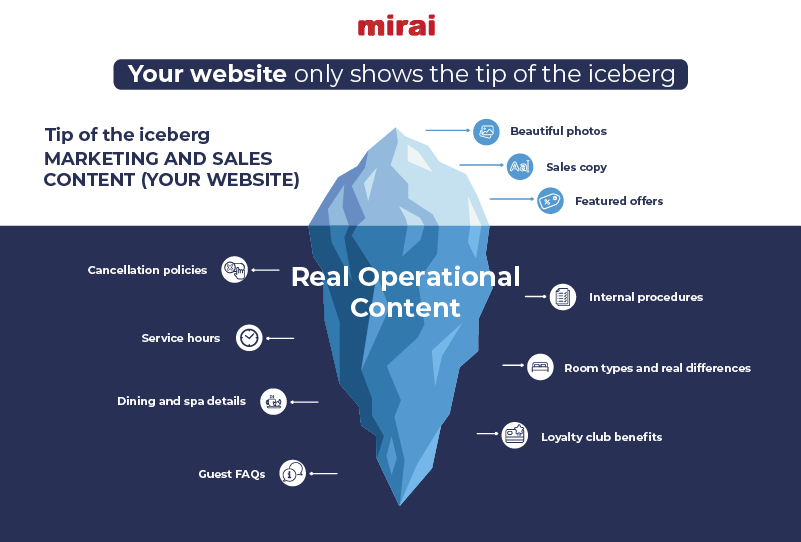
- Inadequate architecture. CMS platforms are designed to edit content easily, not to be queried massively and structurally by an AI. They cannot deliver deep, organized or constantly updated information at the level an MCP requires.
This doesn’t mean web providers cannot evolve, but today they cannot serve as structured repositories or official operational sources for AI.
An opportunity for new specialized providers
The difficulty of defining who should resolve the hotel-content side —and the lack of preparedness of many booking engines— opens the door for new players specializing in structuring large volumes of hotel information in an exhaustive and accessible way. One example is Quicktext’s Q-Data, positioning itself as a “the deepest database in the hotel industry.”
With that same objective, and after discarding our CMS as a tool to serve AIs, at Mirai we built Intelligence, a canonical database explicitly designed to capture, organize and maintain all the hotel’s relevant operational information and expose it through MCP to AI agents (like Sarai) and AI assistants.
A hybrid approach —booking engine for transactional logic + specialized provider for exhaustive content— emerges as the best combination to meet current LLM needs.
The value MCP provides today (and tomorrow)
MCP is not just “future tech.” As of today, it already provides two benefits:
- Repeat guests. Just like hotels offer apps to repeat guests, why not offer them a connector they can install in their preferred AI assistant? Today only Claude, ChatGPT (in dev mode), Perplexity and Grok support MCP natively or experimentally. Google has already signaled that it will incorporate it into Gemini soon. Power users of AI assistants would be delighted to interact with their favorite hotels from ChatGPT or Gemini. As of today, this is the only way for a hotel to have official presence inside an AI assistant.
- Third-party applications. New AI-native consumer applications are emerging —and many more will follow. These are products that live directly inside assistants like ChatGPT or Gemini, without the need for a traditional website, and they aim to become new visibility points for hotels. Examples such as DirectBooker or Connect AI (The Hotels Network) are trying to position themselves in this new environment and compete for user attention just as major OTAs do today. Having an MCP server allows hotels to connect with this new demand if these applications succeed in winning over consumers in their competition with the OTAs.
The value of MCP today is limited but real; the value tomorrow is potentially enormous. Building it now is not a gamble—it is a competitive advantage. When automatic discovery rules arrive, the hotel with a solid MCP will have months of lead time.
- Agentic capabilities. Although still in its early stages, the agentic race between ChatGPT and Gemini has begun. MCP is the path that will allow guests to interact directly with hotels—not just to ask questions but also to book, request invoices or purchase late check-outs.
- Automatic discovery. No assistant (ChatGPT, Gemini, Perplexity) yet offers automatic discovery that natively indexes MCPs. Therefore, having an MCP server will not “connect you to AI.” Nor do magical solutions exist that “connect you to the AIs without user intervention installing a plugin or connector”. Still, all signals point to MCP as the foundation for future automatic discovery. When the rules are defined, having a solid MCP will provide a clear advantage.
OpenAI vs. Google: a duel of titans
Just a month ago, ChatGPT launched Apps, a native way of integrating providers through the MCP protocol. Web scraping is over. Direct integration and official structured content have arrived.
While Gemini has not yet announced full MCP support, Google has explicitly shared its roadmap toward agentic bookings for flights and hotels, something that necessarily requires standardized integrations such as MCP.
Both AI giants pursue the same objective: agentic reservations. OpenAI has the advantage of being first—and in AI, a single month can be worth gold. Still, Google holds important strengths:
- Data authority through Google Business Profile / My Business makes it easier to identify and validate the official source of each business.
- Integration with Google Hotel Ads and near-real-time access to inventory and pricing from thousands of hotels.
- The experience —failed but still experience— of the now-discontinued Book on Google.
In fact, Gemini already displays structured results, Hotel Ads prices, and links to the official direct channel in its ‘AI Mode’ results.
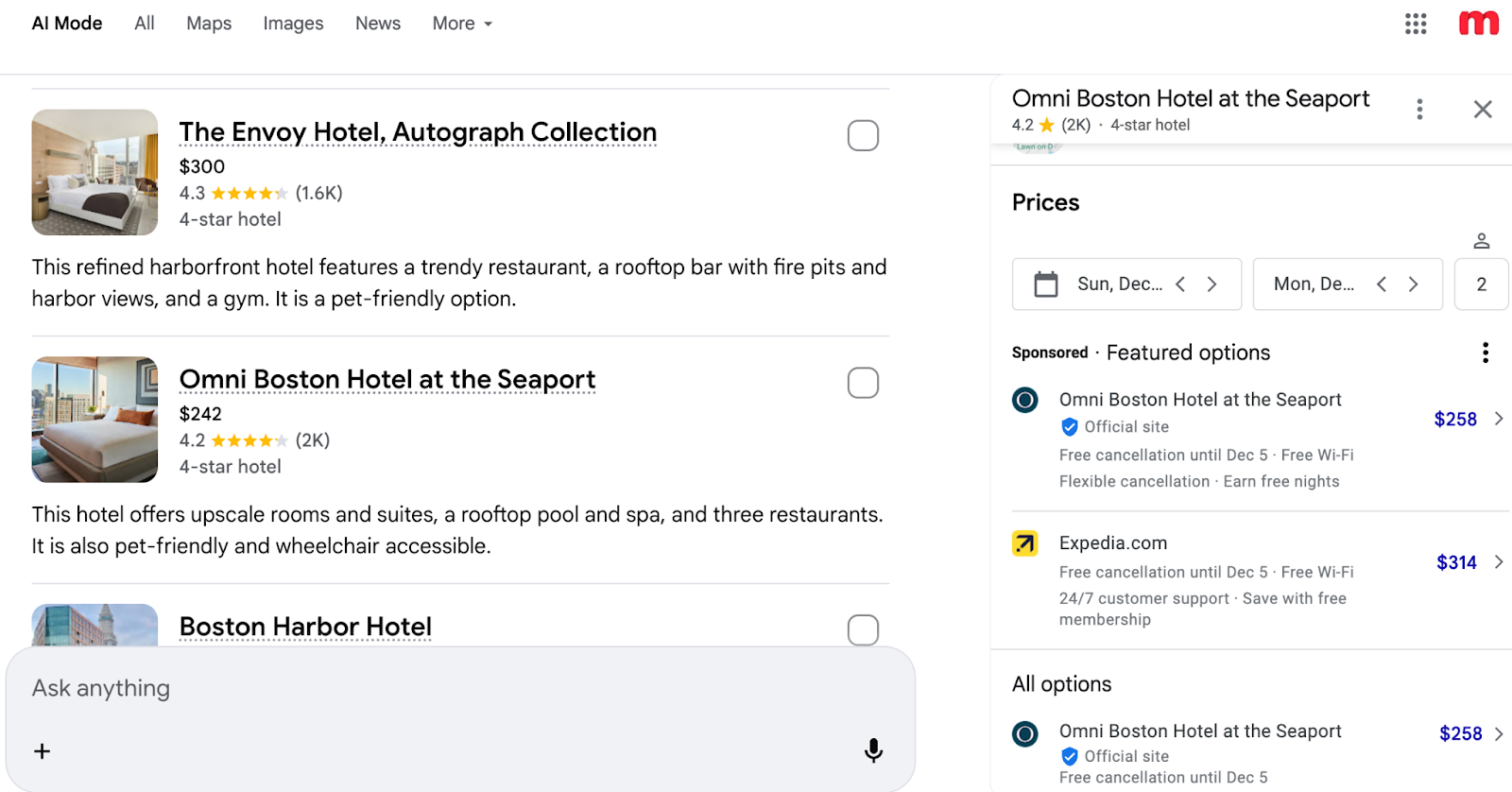
Gemini should not be seen as a secondary actor but as a central competitor in the race for the conversational direct channel.
The competition between both giants will be fierce. This paints a scenario of enormous transformation and accelerated competition in which hotels cannot remain still.
Action plan for hotels
Your objective —whether you are a chain or an independent hotel— should be to build an MCP server. A system that is one of the most strategic components of the new direct distribution ecosystem, that officially represents you inside AI assistants. A possible action plan:
- Localize and organize all hotel content.
- Create a canonical database (SSOT).
- Design and build the MCP with the right providers.
- Offer connectors for AI assistants and third-party apps.
- Prepare for the future marketplace and eventual automatic discovery.
A final nuance for purists: LLMs will never connect directly to an MCP server because they lack execution capabilities. It will always be the AI assistant —ChatGPT, Gemini, Claude— that discovers, manages and queries MCPs as official sources. MCP does not autonomously feed the model today, but in the future it will be the mechanism through which assistants provide LLMs with official and verified content.
Conclusion and a final reflection on agentic AI
Although agentic booking is a major objective for both OpenAI and Google, at Mirai we remain skeptical about its massive short-term adoption. The hotel booking process is complex, requiring the validation of multiple rules, policies, preferences and nuances that do not always fit neatly into a linear transaction. Technology will advance quickly, but time is still needed before users fully trust an AI agent to make the final booking decision on their behalf—if they ever do.
That said, hotels cannot afford to ignore this scenario. They must prepare by building their canonical databases (content and reservations) and by constructing their MCP servers, ultimately allowing the guest to choose where they prefer to book. At Mirai, we are working in this direction and will have news very soon. If agentic AI adoption accelerates, hotels that are not prepared may see their direct channel fall behind. Preparing is not optional, it is strategy.