En español, en français, em português.
Users don’t behave differently in AI assistants than they do in traditional search (Google). In both cases, decisions follow the same pattern:
Discovery → consideration → transaction
These are simply stages of the same funnel, with one goal: make a decision and follow through. Technology doesn’t change this behavior. This is how users behave.
Discovery: AI’s greatest strength
Today, AI assistants excel in the discovery phase or planning phase (also known as awareness), when users are still exploring options without a clear decision. Assistants already capture around 30% of searches at this stage, and that will only increase. The value proposition of AI, led by Gemini and ChatGPT, is undeniable.
Typical discovery queries look like:
- “I’m looking for a hotel in Mallorca for a trip with small kids, within walking distance to the beach”
- “I need a hotel in Madrid with an airport shuttle and breakfast at 6am for a business trip”
Thanks to AI, what used to be the slowest part of the journey has been compressed into hours or a few days at most. So much so that some argue the “new funnel” effectively starts at consideration. This doesn’t just improve the experience. It changes the pace of decision-making.
The efficiency of LLMs in synthesizing information from multiple sources generates highly polished responses and assists in reasoning to reach the best possible decision—far beyond what traditional Google searches deliver.
Why you’re not seeing this in bookings yet
This shift in user behavior is structural. Google itself points to a future, by 2030, where travel discovery and planning will be largely conversational, powered by AI.
And yet, many hotels are asking: “If discovery is changing so dramatically, why am I not seeing any impact on bookings or distribution channels, especially direct vs. OTAs?”
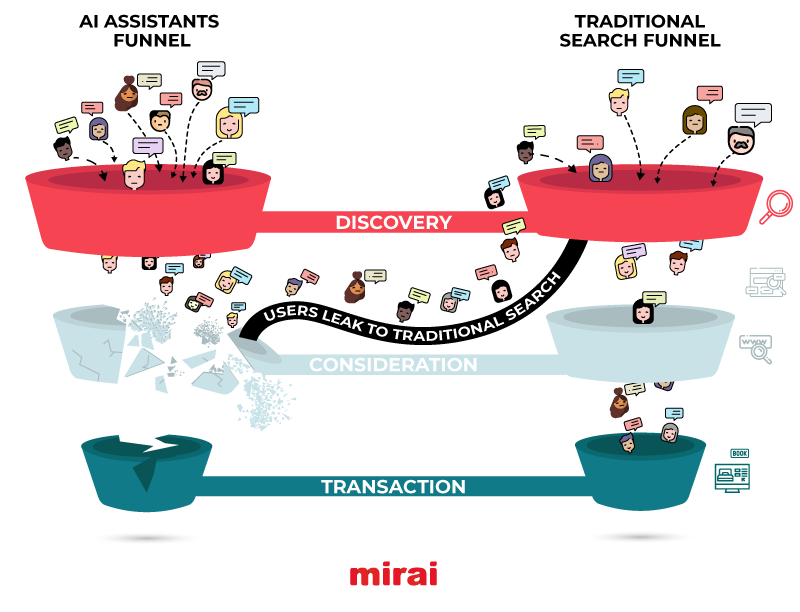
The answer is simple: the AI funnel is broken, or more accurately, incomplete.
Consideration: AI’s Achilles’ heel
AI’s greatest strength, discovery, becomes its biggest weakness where it matters most: when users move down the funnel.
Consideration is the moment when users stop seeking inspiration and start demanding certainty. This is where trust is built. And without trust, there is no booking. This is where the funnel breaks: AI is excellent at generating possibilities, but it struggles to deliver precise, reliable, and verifiable answers required for a purchase decision.
And this is not only critical for users. It’s also where most marketing investment happens. While discovery has historically been about inspiration and branding, consideration is where OTAs, metasearch engines, and hotels compete aggressively for high-intent demand.
The same queries would look something like this in the consideration phase:
- “Hotel in Alcudia, August 15, 6 nights, connecting rooms, crib, kids’ activities, gluten-free breakfast options”
- “Hotel near Madrid T4 airport, September 14, 2 nights, free shuttle starting at 6am, meeting room for 10 people”
Faced with these questions, LLMs, even when combined with real-time Google search, cannot guarantee precise, up-to-date, and reliable information. Without verified data, like actual crib availability or specific dietary options, users lose confidence. And when confidence is missing (as Expedia also points out), they fall back to what they trust: traditional search and aggregators, where information is structured and validated.
From there, the journey returns to familiar territory: OTAs and direct booking channels. This pattern explains why the transformation happening at the top of the funnel has yet to reach the bottom, where bookings actually happen.
Fixing consideration: the real challenge
OpenAI and Google created significant buzz when they announced their ambition to enable users to book hotels directly within their assistants. The path toward agentic AI. It sounded promising. But also, perhaps, premature. The challenges are not just operational or technical. They are behavioral.
Technology is not the main limitation. The real question is adoption. And, above all, the ability to generate enough trust for users to even consider making a booking decision. Without that trust, booking through an assistant remains a leap of faith most travelers are not ready to take.
The transaction phase requires verifiable information, and that level of rigor can only be achieved through structured data. Without it, users receive approximations, which leads to doubt and prevents them from committing to a booking.
Fixing the AI funnel and building trust requires two key elements:
- Reliable, structured data: availability, pricing, and hotel-specific details that LLMs alone and current hotel websites cannot consistently provide.
- Automatic discovery of these data sources: because relying on users to manually install connectors or apps does not scale.
This is why OpenAI has recently signaled a pause in its push toward agentic transactions, not because transactions are unimportant —which they certainly are, given the high number of advertisers willing to pay to showcase their channels— but because the real bottleneck lies one step earlier: consideration. Google, on the other hand, continues to push forward.
Structured content for AI agents: a new visibility layer
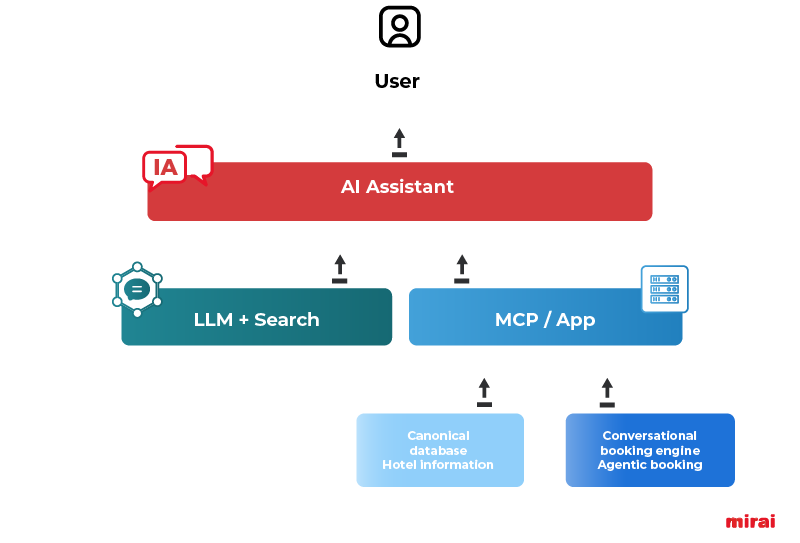
The first condition addresses the need for structured data regarding your hotel’s information, availability, and pricing, as well as access to agentic functions to enable transactions when the time comes.
To achieve this—and while we are currently in the realm of opinion—two alternatives stand out as solid contenders:
1. MCP and similar protocols
Model Context Protocol (MCP) is gaining traction as a way to expose hotel data and capabilities directly to AI assistants. It acts as a structured interface, a hub that allows assistants to access real-time information and, eventually, transactional capabilities.
MCP has gained so much momentum that many hotel companies are already investing in building an MCP infrastructure, positioning themselves for the moment assistants solve “automatic discovery”. When that day comes, MCP will play a vital role in both the consideration and transaction stages.
While MCP is one of the most prominent approaches, it is not the only one. Other emerging frameworks, such as UCP (Universal Control Protocol) or ACP (Agent Client Protocol), aim to solve the same problem: standardized access to structured data and services.
2. Apps within assistants
The second option is for assistants to evolve into ecosystems of apps or installable integrations where providers—hotels—publish their services. In this scenario, AI assistants would play a role more akin to an “operating system”, similar to iOS or Android, supported by an app ecosystem.
Apps across different marketplaces, such as ChatGPT, also rely on MCP, so this would essentially be a derivative of the previous case.
Both MCP and Apps are already functional and operational realities. Therefore, the first condition is already met; they are simply waiting for adoption by hotels.
Google’s structural advantage
In this context of access to structured information, not all assistants start from the same position.Google has a significant advantage. It has spent years building structured, verified data ecosystems through products like Google Business Profile, Google Hotel Ads, and Google Flights, as well as retail integrations that expose inventory and pricing directly in their interfaces.
This gives Gemini a stronger foundation to tackle the consideration phase, with more reliable and connected data. Other assistants, like ChatGPT, will need to build this layer from scratch or rely on emerging architectures like MCP.
Automatic discovery: the SEO of the AI era
It is in this second condition—which remains unresolved—where the real problem lies. While the means to connect structured content already exists, we face a critical barrier: the installation of these sources is still manual. For an assistant to access your real-time data today, the user must manually install your specific connector or app and explicitly invoke its use—something that simply does not scale within traveler behavior.
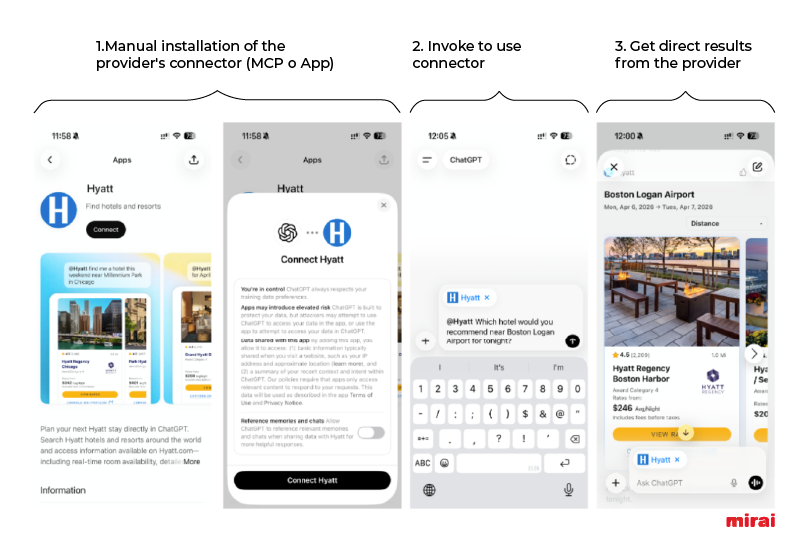
Having an MCP or an app today does not guarantee visibility. It does not improve your position in AI responses. Its value is latent and strategic.
The current value of MCP is latent and strategic. It is crucial to understand this concept. Many false expectations have been set, carrying the risk that hotels might turn their backs on this revolution because they perceive it as “smoke and mirrors”.
In contrast, we are just one step away from a total shift where users explore, consider, and decide entirely within the AI interface. This will happen when AI automatically discovers data sources (or agentic discovery). In this model, assistants won’t wait for you to tell them where you are; they will actively search the entire web for data sources they can process in milliseconds. This is where traditional SEO evolves into a new technical discipline.
In this new scenario, success won’t come just from being “found” by the AI, but from being validated by it. We are moving from a model of simple indexing to one of “Verified Discovery”. For an AI agent to confidently recommend your hotel autonomously, reading a catchy description on your website won’t be enough; it will need to certify, through structured data and trust protocols, that your attributes (such as that “available crib” or “gluten-free breakfast”) are a transactional certainty. In automatic discovery, any content that is not verifiable will be treated as “noise”, and the AI will simply ignore it to avoid the risk of hallucination.
This model is far more scalable, but it requires a technical architecture where the hotel exposes its data in an open and standardized way. This brings us back to the importance of context protocols (such as MCP, UCP, or ACP). Participating in them is not just a technical upgrade; it is the only way for your direct channel to be “visible” to AI systems.
In this setting, MCP becomes a kind of SEO for assistants, making your hotel “understandable” to decision-making systems. Those who build this infrastructure today will be the ones who receive priority when assistants decide which interfaces are reliable and which to prioritize during the consideration phase.
MCP does not guarantee visibility or sales. What it does is make that visibility possible.
The necessary alignment of the ecosystem
The industry is approaching an inflection point where incentives are beginning to align. If the consideration layer is solved through structured data, the benefits are clear:
- For AI assistants, they retain users throughout the entire decision journey, reducing dependence on aggregators in the advanced stages of the funnel. It would also allow them to compete for a share of the advertising investment at this stage and, ultimately, move closer to the final goal of handling the transaction
- For hotels, exposing their information, services, inventory, and pricing directly to AI to attract customers during the critical comparison phase, as well as competing with OTAs where they are at their strongest.
- For users, they receive precise, reliable, real-time answers eliminating the need to search through dozens of websites to confirm operational details.
Conclusion
AI is already changing how decisions start. Its immediate goal is to move one step further down the funnel and influence how those decisions end. In doing so, assistants are pursuing two major outcomes: retaining users instead of sending them back to search, and capturing a massive pool of advertisers eager to invest in new placements.
Not long ago, the question was whether assistants would cover the entire funnel. Today, the question is when. But that shift will not be uniform. Adoption will vary across user segments and travel types, and not every use case will be ready to make that leap at the same time. Some may never be.
The battle for consideration will largely be won by the assistants themselves. Hotels will not decide which architecture prevails, but they will decide whether they want to be part of it. If they don’t, OTAs will take that space for them.
We’ve seen this before. In the search era, mastering SEO and SEM was essential to building direct channels. A new ecosystem is now emerging, one that will reward not just visibility, but verifiability for machines. Preparing your data infrastructure today (such as MCP) is not merely a technical option; it is a strategy to ensure that when AI searches for certainties to recommend a hotel, yours is the one aligned with its language.
In the race to dominate the consideration phase, not all hotels will start at the same line. In the era of AI, the winner won’t be the one who is most visible, but the one who is most verifiable.