En español, en français, em português.
During more than two decades, the website has been the center of hotel online distribution. The user navigated, compared rooms and finally made their reservation. The website became a stable model upon which the hotel industry built its digital sales project with varying degrees of success.
But this model is starting to change.
More and more travelers are asking questions instead of browsing pages. We want immediate answers. We have become impatient.
- “Do you have family rooms for this weekend?”
- “Price for tonight and one person with breakfast and late checkout?”
- “I want a room with a king bed and ocean views from June 15 to 18”
The curious thing is that conversation has always been the most natural way to interact. This is proven by the fact that many hotels continue to generate a very significant part of their sales by phone and email.
To cater to this “new” conversational user, our first instinct was the approach that seemed easiest and most intuitive: let’s adapt our successful web-based model. That was also the first thing we thought of at Mirai. Before long, however, what seemed logical and simple ceased to be so. What were previously advantages turned into problems and doubts. We paused and reflected: should we continue adapting, or start from scratch? We chose the latter.
The website will lose its prominence… but by how much, and when?
Since the website wasn’t designed to handle conversations, we users have learned to interact in a different way: by browsing pages, clicking links and filling out forms. And we have turned it into a habit.
But this is starting to change.
AI assistants, such as ChatGPT or Gemini, are able to understand natural language and hold conversations with users thanks to large language models (LLMs), something that, until recently, was only possible between people.
And if users can interact in real time by chatting—without having to make a phone call—, the role of the website as an interface will be threatened, as it will face increasing competition from 100% conversational channels that operate outside a browser, such as WhatsApp and, above all, the rise of AI assistants like ChatGPT or Gemini themselves. The website will remain a very important direct channel, but it will no longer be the sole point of interaction with the hotel. How will these new “direct channels” be adopted? Only time will tell.
For the hotel industry this has a clear implication: its direct channel must be able to understand, respond to, and close a reservation within a conversation, regardless of the platform on which it takes place.
AI, the rapid evolution from product to infrastructure
Most providers —including us at Mirai— initially viewed AI as new products or new features built on top of existing infrastructure: some examples that are still common include adding AI to a chatbot, AI-driven booking engine functionality that adapts its behavior, and making the engine MCP-ready.
After nearly two years of innovating, testing and, above all, making mistakes and starting over several times, we have reached another conclusion: if AI is changing the paradigm and shifting users from the website to conversation, the systems used by hotels must be natively designed to be able to operate in that environment.
And that is not solved simply by adding a new component or layer to the existing system. It requires something more structural: an infrastructure designed for a conversational and agent-based environment.
An AI infrastructure that feeds on the same data
When you open this new conversational channel for your business, an important question quickly arises: where do the data and capabilities used by these assistants come from? The answer is usually: from a proprietary database that is disconnected from your systems. And this creates a twofold problem: on the one hand, the cost of inconsistency (giving one answer on the website and another via WhatsApp erodes customer trust) and, on the other, the inability to scale. If the content, inventory and pricing database is not the same, the user will feel like they are talking to two different companies.
All your direct channel interfaces —the website, the contact center, the AI conversational assistants— must operate on the same knowledge base and the same operational capabilities. This ensures a consistent guest experience. A traveler could check availability on your website, book through your booking engine, modify the reservation later via WhatsApp, and be able to cancel it through ChatGPT.
If the base (covering content and inventory, price and reservations) differs between web and conversational engines, the user experience will be poor, and they will perceive that they are talking to two different systems, an undesirable scenario. Conversational infrastructure should be built as an evolution of the hotel’s existing digital infrastructure. The solution must be born out of your current systems, not as a plugin.
The reality, however, is that many hotels still do not have systems prepared to operate in this way. There are many rigid and outdated technologies that are deeply embedded into hotel operations. In such cases, it is possible to deploy a conversational AI infrastructure that complements existing systems, but it is vital that it draws on the same content—particularly inventory, rates, and offers—with the channel manager, CRS or PMS serving as the most logical source to ensure this consistency.
The five layers of a conversational and agent-based infrastructure
To prepare for this new conversational environment, hotel systems must rely on an infrastructure composed of several key layers that interact with one another to form a new operational architecture.
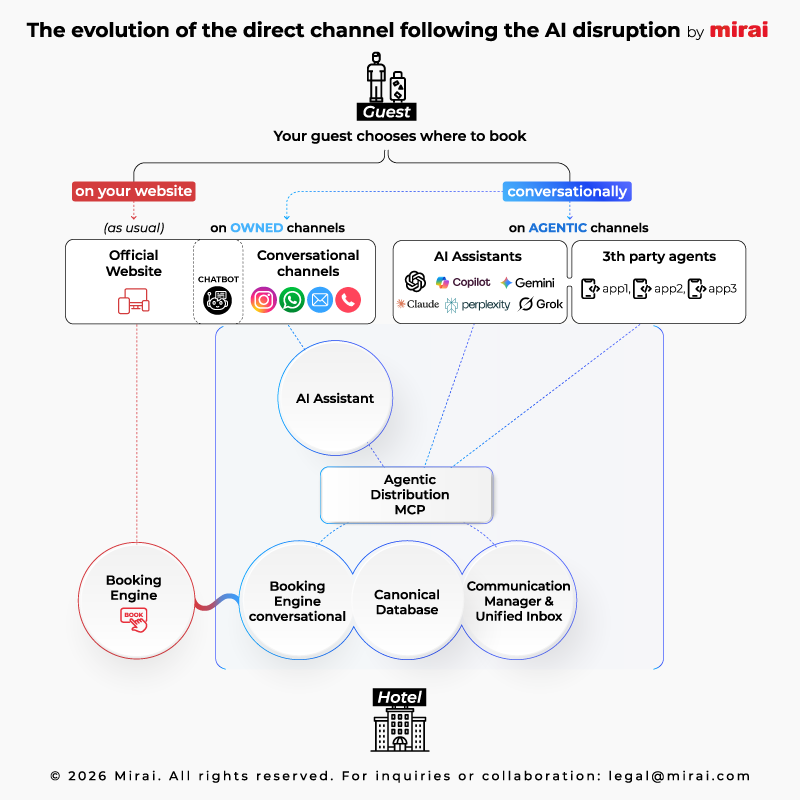
1. Booking engine prepared for conversation
The first key element is the booking engine.
Until now, the booking engine was designed for forms and web navigation. But in a conversational environment, the system must be able to interpret user intent, provide price quotes, check availability and complete the reservation within the conversation.
This implies a significant change: the booking engine is no longer just a website; it has become a transactional capability accessible from any conversational interface.
2. Structured hotel database readable by agents
For a conversational system to work correctly, it needs reliable, structured and updated information.
Today, in many hotels, that information is scattered across:
- Web pages
- PDFs
- Channel descriptions
- Manual responses from the team
An AI assistant, however, needs a clear knowledge base where it can find answers to questions such as:
- Opening hours
- Services and facilities
- Room types
- Policies
- Places of interest
This database serves as the single source of truth for machines and assistants. Without it, any AI system will end up providing incomplete or incorrect answers. Nearly 60% of the questions travelers ask are about the hotel itself, not the reservation. To secure a reservation, we must first correctly answer users’ questions. Otherwise, the user may leave your direct channel in search of that answer.
Therefore, the first step for any hotel looking to prepare for AI is to organize and structure its knowledge. The master or canonical database is a critical starting point.
3. Conversational assistant
On top of that operational foundation —conversational booking engine and knowledge base— comes the third element: the AI assistant. It is the component that, thanks to the power of LLMs, enables you to understand the guest’s natural language and manage the interaction. This includes interpreting questions in different languages, maintaining the context of the conversation, guiding the user and connecting to the booking engine when necessary. The assistant should be able to automate conversations across multiple channels such as web chatbots, WhatsApp, Instagram, email, and the telephone (conversational but voice-based).
What many hotels currently do manually can now be largely automated, improving operational and cost efficiency as well as guest satisfaction. This does not mean a complete replacement of human teams, but rather freeing them from repetitive tasks and inquiries so they can focus on higher-value work: pursuing leads, closing complex reservations or stepping in during conversations when truly necessary.
4. Connection with external agents via MCP
Once your own conversational channels are automated, the next step is to open up your hotel to the new intermediaries of the AI era: intelligent agents such as ChatGPT, Gemini or Claude.
For this to work, hotels systems must be able to display their availability, prices and booking capacity to those agents in a secure and structured way. It is what is called Agent-based AI.
That is where interfaces like MCP -Model Context Protocol- come in, allowing the hotel to provide its own controlled and structured content to AI assistants, as well as equipping them with booking capabilities.
It is important, however, to clarify the current scope of MCP. Having an MCP server does not automatically imply greater visibility in AI assistants today. The discovery layer —how assistants find and prioritize hotels— is still an area yet to evolve and will depend largely on the assistants themselves.
5. Governance and control
Finally, if you are going to allow your guests to chat with you, you need a layer of governance and control. You cannot go from a web channel where you measure everything to a conversational channel where you don’t know what is going on.
Before opening conversational channels, you should ensure that you can:
- see what conversations are taking place
- monitor responses
- intervene in conversations when necessary
- analyze performance and user satisfaction
- continuously improve the system to provide better and better responses
The Mirai Omnichannel team can also handle this for you.
AI managing conversations cannot be a black box. It must be a transparent and governable tool.
How to start building this infrastructure?
The transition to a conversational environment does not happen overnight and must be planned carefully but decisively.
The starting point is your current providers, mainly the booking engine, CRS/channel manager and PMS. They are the prime candidates to provide you with this infrastructure and integrated it with your existing systems.
The order in which you assemble the pieces should be as follows:
Step 1 — structure your hotel’s knowledge base
Create a clear, up-to-date database of your hotel’s information. Ensure it is in a structured format that can be read by machines or agents.
Step 2 — ensure the booking engine can operate conversationally
Expand your booking engine’s capabilities so it can provide a quote and, very importantly, also close bookings based on intent, not just a form.
Step 3 — deploy a conversational assistant
Incorporate an AI assistant that gives you understanding and automates conversations with your guests across as many channels as possible.
Step 4 — open the infrastructure to external agents
Open your infrastructure to AI assistants such as ChatGPT or Gemini through a system like MCP, where agents can consult and book natively and directly, bypassing any interaction with your website.
Step 5 — establish mechanisms for continuous monitoring and improvement
Finally, add a tool that gives you visibility and traceability of what is happening. One that allows you to intervene if the conversation requires it and provides insights on how to improve your knowledge based on the questions customers ask.
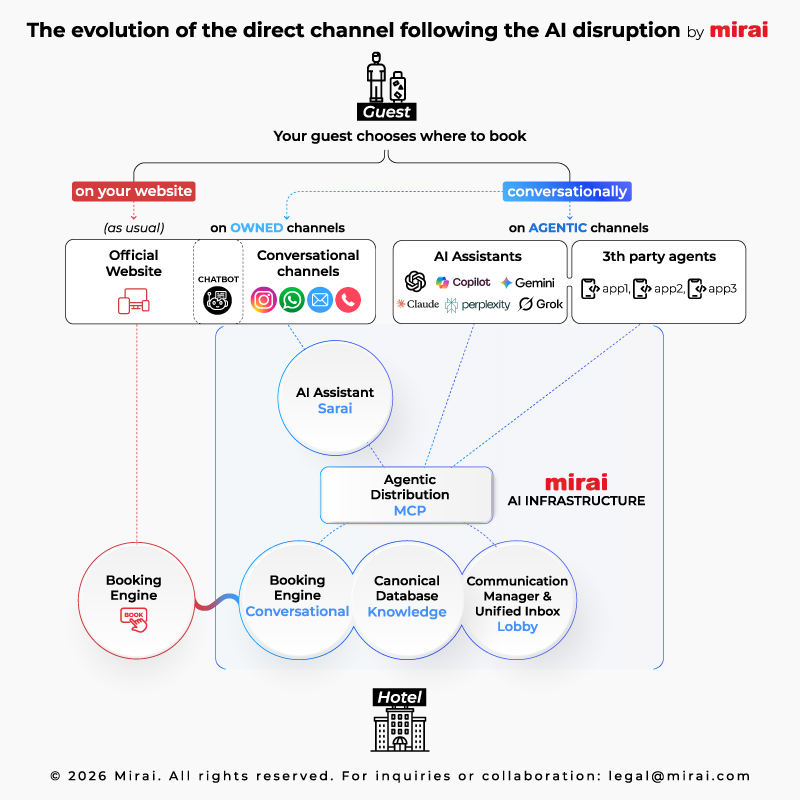
At Mirai, we already offer our clients our AI infrastructure that is natively integrated with the web booking engine and the rest of the stack.
- Conversational booking engine: to respond to your customers in conversations
- Sarai: the AI assistant that understands and responds to your customers
- Knowledge: the canonical or master database
- MCP: the interface that connects you to AI assistants like ChatGPT
- Lobby: the tool that provides governance, transparency, traceability, and the ability to intervene
An opportunity to strengthen direct sales
The arrival of conversational AI represents more than just a technological change. It can also redefine the relationship between hotels and guests.
If hotels build the right infrastructure, they will be able to interact directly with travelers on any channel where the conversation arises, maintaining control of the relationship and the sale. And gaining a competitive advantage over OTAs.
Instead of merely reacting to market changes, they have the opportunity to lead this new era.