En español, en francés, en portugués.
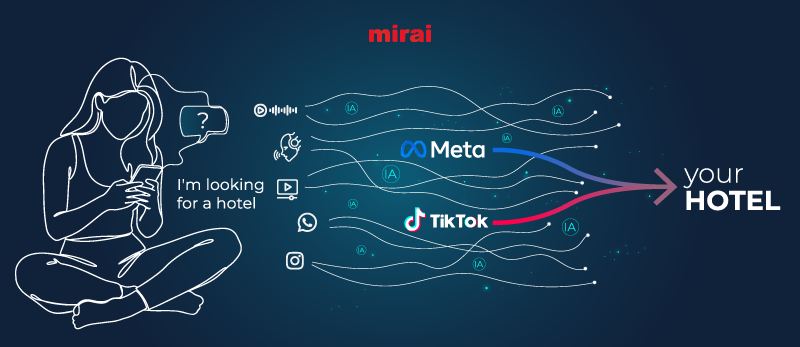
If the pace of change that AI is bringing to the main digital marketing channels is dizzying, the AI revolution is much greater in Social Ads. Instagram and TikTok are the new search engines for Gen Z and are revolutionising the discovery phase, blurring the line between initial contact and booking. Social Ads are key because they are the fastest-growing channels and because of their ability to connect with new travellers: what are these AI-powered platforms doing to attract new users? In this article, we break down what you should already be putting into practice and the most important factors to bear in mind for 2027.
Why are social channels key in today’s and tomorrow’s marketing?
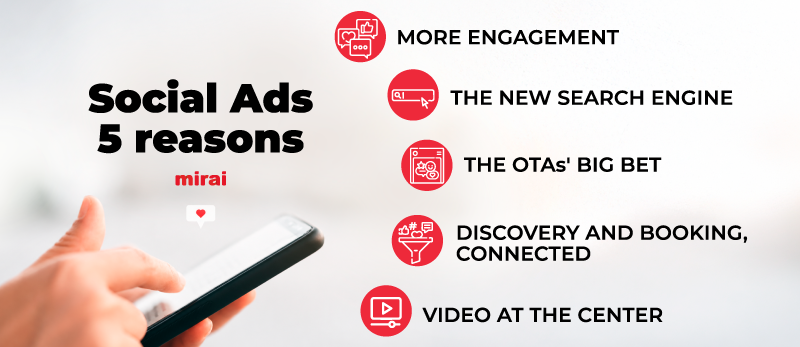
Social media is essential for understanding how future travellers behave, so running ads on these channels is key to continuing to impact users or those who are already familiar with your brand. Here are the five big reasons to bet on Social Ads:
1. Engagement and interaction: Social Media’s key differentiator
What sets Social Ads apart from SEM is their ability to capture immersive attention. Short videos on social networks generate 42% more engagement than static ads in the tourism industry (Travel Tourism Report, Amra & Elma, 2026). TikTok leads the way in this area with an average engagement rate of 3.7% per follower, making the social environment the only one capable of turning inspiration into direct intent.
2. The shift in discovery channels towards vertical video
Users prefer a 15-second video in which a guest shows them around the room rather than reading the hotel’s website. According to data from Adobe or Sprout Social, more than 40% of young people use TikTok or Instagram as their primary search engine rather Google. Furthermore, 49% actively use them to discover destinations or restaurants, and 32% state they have booked a hotel after discovering it on these social media platforms.
3. The OTA machinery and the focus on AI-powered social ads
OTAs compete with hoteliers in terms of technological innovation to attract customers before they even start searching. Booking increased its Social Media investment by +13% YoY in 2025 (source: Booking Holdings). This figure forms part of a combined total of over $20,000M invested in marketing between Booking and Expedia (Phocuswright), using predictive AI to intercept travellers on social media.
4. The marketing funnel revolutionised by the Social channel
The linear marketing funnel has given rise to a certain degree of chaos in which discovery, recommendation and booking all take place simultaneously. According to an Ipsos study, 51% of hotel buyers would book an unfamiliar brand if AI personalised the offer or recommended it to them. Social media platforms are harnessing these algorithms to link discovery with direct booking, thereby reducing the advantage enjoyed by traditional brands.
5. The power of visual assets and AI-powered editing suites
In Social Ads, visual assets are the absolute key to conversion. The platform’s AI suites allow editing, adapting vertical formats and generating dynamic variants instantly. Dynamic visual content personalisation using AI reduces CPA by up to 22%, enhancing the user experience, engagement rate and conversion rate by delivering the ideal ad.
These five points show that investing in Social Ads is not merely a media option, but the definitive strategy for attracting travellers of today and tomorrow. Thanks to the impact of vertical video, social search engines and the rise of AI, this channel breaks down the traditional funnel to merge inspiration, personalisation and instant booking. Any business that fails to lead the way with its visual and interactive presence on social media will yield customer control to the technological might of OTAs.
Let us now take a look at what Meta Ads (Instagram, Facebook, WhatsApp) and TikTok Ads have to offer in this context.
Meta Ads: the death of targeting and the reign of Andromeda
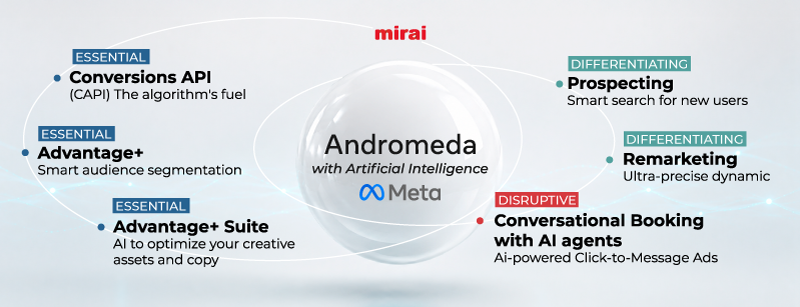
Meta has evolved from a social network into a predictive recommendation system. In 2026, the ad manager consolidates the use of Andromeda, a new architecture engine that uses AI on a large scale. It no longer asks you to search for your audience; it asks you to provide quality content so that its algorithm can decide who is interested in it.
What should we already be using in Meta Ads with AI?
- Conversions API (CAPI): the algorithm’s lifeblood. Without a direct connection between your booking engine and Meta, the AI is blind. The bare minimum these days is to send clean data so that Andromeda knows exactly who has booked and who has not.
- Advantage+ smart audience targeting: hoteliers no longer choose predefined or similar audiences from their database. This smart campaign uses AI to analyse content we publish and select the right user to show it to. To do this, it analyses millions of signals and takes into account the browsing behaviour of the user who will be targeted by the ad.
- The Advantage+ Suite provides you with AI to optimise your visual assets and text. Ads are dynamic and self-adjusting, allowing you to hyper-personalise them, generate more interest among users you impact, and offer more versions of your visual assets.
The key differentiator: The union between Advantage+ and the catalogue
The catalogue is a campaign setting that allows you to connect different images or videos and even link it to the hotel’s pricing feed. This format, embedded within a smart campaign like Advantage+, is a winning combination, as it will allow you to:
- Prospecting, or smart targeting of new users: Advantage+ is now able to select users who do not know your hotel and who, based on their behavioural patterns, it knows will be interested in what you offer. Using the catalogue, it also personalises the ad to show them what interests them most (for example, the pool) and can even display a price it knows they might find appealing.
- Ultra-precise dynamic remarketing: if a user has already shown interest in your hotel, visited your page and looked at, for example, the “Spa and massages” section, with new dynamic remarketing we can retarget them with an ad related to their search and a direct link to the booking page, reducing friction in the purchasing process.
The most disruptive innovation: Conversational Booking with AI agents
The future of Meta Ads (which we must bear in mind for 2027), as with other channels, lies in engaging the user in a conversation where queries can be resolved with real-time dynamic data, ultimately resulting in a booking being made via a WhatsApp conversation or Instagram direct messages. These are known as AI-powered Click-to-Message Ads and can combine the algorithm (Andromeda) with our hotel’s AI assistant.
- Extendable AI agents for Meta Ads: while Andromeda searches for the customer, the AI agent we have set up for our hotel is the one talking to them via messaging platforms (WhatsApp, Messenger, Instagram Direct).
- The game-changer: the ad does not lead to an external website. When clicked, it opens a chat where the hotel’s AI agent (trained on your inventory and sales policy) engages in a natural conversation. It answers queries about pets, parking or views, and closes the booking directly in WhatsApp or Instagram.
- The impact: the complete simplification of the funnel. We have moved from a user experience riddled with clicks to a single interaction where Meta’s AI (Andromeda) finds the traveller and the hotel’s own conversational AI sells them the stay.
TikTok Ads: the new visual discovery engine for travel
TikTok has established itself as the new Google for new generations, but with a very different approach: the user does not search for information; instead, information finds the user through entertainment. Furthermore, Symphony, the social network’s AI suite, has eliminated the need to be a video editing expert.
What should we already be using in TikTok Ads with AI?
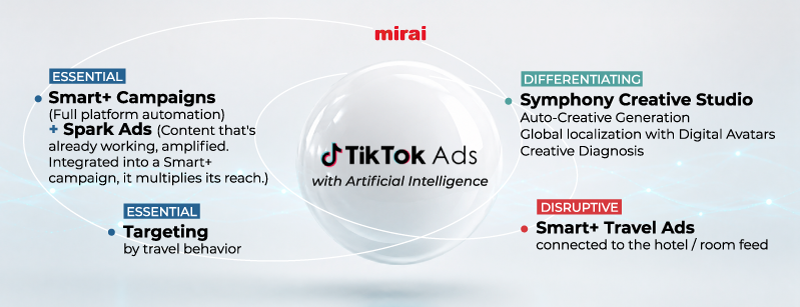
- Smart+ Campaigns: full platform automation. The hotelier simply provides the videos and the country; TikTok’s AI decides who to show the ad to based on the user’s viewing history.
- Spark Ads: content that is already performing well, amplified. It allows you to turn an organic post – whether your own or that of a creator who has authorised it – into an ad. What makes it unique is that all engagement generated during promotion – views, comments and followers – remains permanently on the original post. It is the only paid format that also builds your own asset: when the campaign ends, the growth remains. Integrated into a Smart+ campaign, it multiplies your reach.
- Targeting by travel behaviour: AI identifies users who not only browse trips, but also interact with guides and maps within the app, enabling targeting at the moment of high intent.
The key differentiator: Symphony Creative Studio
Symphony is TikTok’s generative AI ecosystem, which has democratised high-end content production for hotels of all sizes.
- Auto-Creative Generation: AI takes still images from your website or raw footage from your staff and automatically edits them with trending music, dynamic cuts and transitions that the algorithm knows work.
- Global localisation with Digital Avatars: you can create a “virtual ambassador” or digitally clone someone from your team. Symphony’s AI allows that avatar to speak 15 languages flawlessly (with synchronised lip-syncing), enabling a hotel in Mallorca to run ads in German, Japanese or English in a native-sounding way and with no extra production costs.
- Creative Diagnosis: before launching the ad, Symphony’s AI analyses the video and gives you a “probability of success” score based on trends in the travel industry.
Symphony offers a unique tool whose main value is not inventing content, but rather using AI to expand and optimise what you already have, continuing to complement it with high-quality visual material of all the hotel’s facilities (which remains important to maintain).
The most disruptive innovation: Smart+ Travel Ads connected to the hotels/rooms feed
- Native integration of the hotels feed: TikTok no longer just shows pretty videos; it connects your room catalogue in real time.
- Automated Travel Cards: during video playback, an interactive card appears showing the property’s name, its rating, the price and a direct link to the booking. Cards appear within a few seconds of the video starting and rotate automatically, showing each user the properties that the travel intent model considers relevant to them.
- Disruption: moving from discovery to friction-free booking. TikTok becomes a direct sales channel where Symphony’s AI creates the content and Smart+’s AI finds the guest by showing them content tailored to your actual inventory. This closes the loop between inspiration and transaction within a single app.
Metasearch engines: the AI-driven evolution of the key showcase for direct channel profitability
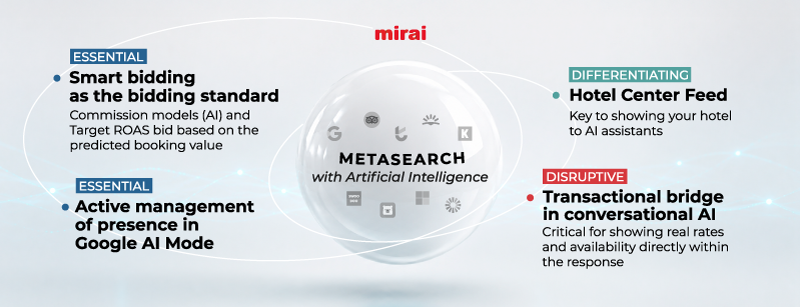
In the hotel industry, the metasearch engine is the final battleground before a booking is made. Here, AI does not just seek visibility; it ensures that hoteliers compete on a level playing field (or even gain an advantage) against the strength of OTAs, by simplifying management and opening up a new dimension of visibility that goes far beyond traditional price comparison sites.
What should we already be using in AI-powered Metasearch?
- Smart bidding as the standard bidding method. There is an important change here: metasearch bidding models have changed permanently. Google Hotel Ads eliminated commission-based bidding in February 2025. trivago migrated to a pure CPA model in September 2025. The new commission and target ROAS models are based on AI algorithms and bid on the expected value of the booking. No one should use manual bid management models.
- Active management of presence in Google AI Mode. Having an active listing on Google Hotel Ads is no longer enough. These days, Google integrates hotel recommendations with real-time prices and availability directly within its conversational responses in AI Mode. Paid ads take priority; free listings risk disappearing from the booking flow if there is no active investment behind them.
The key differentiator: The Hotel Center feed as the driving force behind all of Google’s AI
If photos and videos are the lifeblood of social media platforms, the price and availability feed is the fuel for Google: without clean, real-time data, no AI campaign can learn, optimise or recommend your hotel at the key moment.
- The Hotel Center feed now powers Google’s entire advertising ecosystem, not just metasearch. The same price and availability feed enriches Search, Performance Max and Demand Gen campaigns in real time. Without it, your hotel will not generate booking cards in Google’s conversational responses, regardless of your investment in SEO or other formats.
- Feed quality is the new competitive advantage. Google directly penalises feeds with latency or price discrepancies: when a user clicks on an ad and finds a different price in the booking engine, the quality score drops and the algorithm reduces the property’s visibility across all platforms simultaneously. A feed updated in real time, with consistent prices and complete attributes, is not just a technical requirement for participation; it is the quality signal on which AI decides whether your hotel deserves to appear or not.
- Choosing a good connectivity partner is a marketing decision, not a technical one. Google’s AI can only recommend what it understands. An authorised partner that guarantees real-time synchronisation, comprehensive property details and control over price discrepancies is today the starting point for any AI strategy on Google to work: from metasearch to AI Mode.
The most disruptive innovation: Metasearch as a transactional bridge in conversational AI
With the paradigm shift introduced by AI agents, metasearch engines are being transformed and integrated into the conversational AI flow.
When a traveller asks an AI assistant: “Which hotel in Lisbon would you recommend for a romantic getaway for less than €200 a night?” The assistant processes the request by combining the hotel’s visibility layers (its organic knowledge about the property) with real-time transactional data. And this is where metasearch plays its decisive role: to display actual rates and availability within the response, the AI draws on the APIs of Metasearch platforms.
If your hotel has an active Metasearch strategy and a fully optimised Hotel Center feed, you can ensure that the booking option displayed by the AI is that of your direct channel. Without this paid, structured presence, the AI will continue to answer the user, but the booking will be channelled through OTAs that are investing in those metasearch engines.
Ultimately, conversational AI does not replace the metasearch engine: it turns it into the essential gateway for qualified AI traffic to translate into direct sales for the hotel.
Conclusion: The new paradigm for lead generation and conversion
This second part confirms that the hotel marketing funnel is no longer linear: Social Ads and Metasearch engines have a direct impact, in different ways, on both the discovery and booking stages. On the one hand, Meta and TikTok have ceased to be mere showcases and have become visual search engines and direct sales channels where smart campaigns (Advantage+, Smart+) and conversational selling shorten the path to booking. On the other hand, Metasearch engines are no longer just price comparison tools: powered by Smart Bidding and real-time feeds, they are crucial in ensuring that conversational AI (Google AI Mode) displays your direct channel’s rates before OTAs snap up the customer.
A roadmap for hoteliers: how to stay up to date
To capitalise on this transformation and maintain direct sales competitiveness, the strategy must focus on six key pillars:
- Simple structures and AI-powered campaigns: reduce account fragmentation and rely on automation (Advantage+, Smart+, Smart Bidding on Metasearch) so the algorithm optimises audiences and bids.
- Dynamic feeds connected to Social Ads: Synchronise real-time prices and availability across Google Center, Meta and TikTok catalogues to display dynamic offers.
- Ongoing creative asset strategy: design a steady stream of vertical video and high-quality content; the visual assets are today the main driver of AI on social media.
- Clean, latency-free data: implement the Conversions API (CAPI) and rely on a connectivity partner that guarantees zero price discrepancies to avoid being penalised by the algorithms.
- Constant monitoring and application of AI innovations: quickly adapt and integrate new platform tools (Advantage+, Symphony, AI agents) before the competition does. Leverage and connect our AI agent with social media strategies.
- Full alignment with direct sales: ensure that every paid impression and every AI response aligns with the hotel’s distribution, margin and occupancy strategy.
AI is already in charge of executing tactics with unprecedented speed and precision. The hotelier’s role is to feed those algorithms with high-quality assets, robust technical integrations and a clear strategic vision. At Mirai, we work every day to ensure your direct channel is ready to lead this new era. Shall we get started?