En español, en français, em português.
At Mirai, we are already deploying our hotel clients’ first plugins on ChatGPT. Users and guests at Hotel Emperador and Hotel Moderno in Madrid, as well as the Porcel Hoteles chain in Granada, can now check information and book directly with them from ChatGPT using natural language.
Originally called Apps by ChatGPT, OpenAI recently updated the terminology and structure of its ecosystem, transforming the App Directory into the Plugin Directory. Although the industry still commonly refers to them as Apps, the correct term is plugins, and that is the one we will use throughout this article.
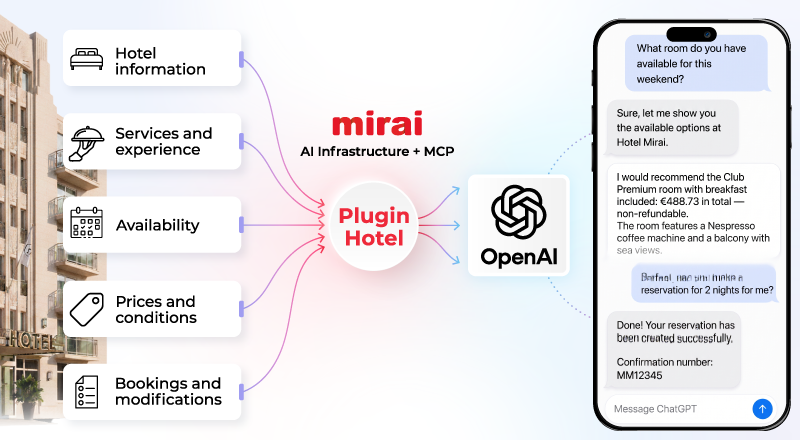
What plugins are and what they are used for
A plugin is a connection that enables ChatGPT to access external services to retrieve information, use tools, and carry out actions on behalf of the user. In the case of a hotel, it allows guests to interact with it directly from ChatGPT, without having to leave the conversation.
This interaction can range from answering queries using the hotel’s knowledge base to executing real-time capabilities. It is precisely this last aspect that is the most differential and innovative: guests can perform actions such as checking availability and prices for specific dates and occupancy, changing currencies, filtering results, exploring promotions and rooms, making a booking, or modifying or canceling an existing one.
Let’s look at a practical example of one of these capabilities. Something like making a hotel booking naturally without leaving ChatGPT.
From the web direct channel to the agentic channel
The rise of AI agents is creating a new agentic distribution ecosystem that will coexist alongside the web. Just as hotels have spent decades building their online presence and direct channel for human use, they must now also prepare them to be used by AI agents. This transformation by no means implies the demise of the website, though it does pose significant challenges for the web ecosystem as we know it today.
The fundamental difference lies in who interacts with the technology. In the web ecosystem, the user searches, compares, browses, and personally performs the actions. In the agentic ecosystem, that same user will be able to progressively delegate these tasks to an assistant acting on their behalf.
This carries major technological implications. For decades we have built interfaces for humans: websites and booking engines that allow a person to discover a hotel, check availability, compare rooms and rates, and complete a booking.
Agents, however, need something different: direct access to knowledge and capabilities they can understand and use. And both dimensions are critical. Let’s illustrate the difference with a few examples.
- Knowing whether a hotel allows pets is knowledge. Checking availability for two adults and one child for specific dates is a capability.
- Knowing rate conditions is knowledge. Quoting a rate, applying loyalty program conditions, booking it, and later modifying or canceling the booking are capabilities.
That is why at Mirai we believe one of the core requirements to compete in this new ecosystem will be for hotels to expose both their knowledge and their direct channel capabilities to AI agents.
Therefore, the debate no longer stops at “How do I make my hotel discoverable for AIs?”. The next question is far more ambitious: “How do I make my direct channel operational for AIs?”. Plugins are the way to achieve this within the OpenAI ecosystem.
The infrastructure preceded the plugin
Our strategy did not begin with ChatGPT plugins. It started much earlier.
We have been working for some time on building an AI infrastructure that centralizes hotel knowledge and allows external systems to access both that knowledge and transactional capabilities in a structured manner.
A fundamental piece of this architecture is MCP (Model Context Protocol).
On top of this layer, we have been exposing tools that allow users to check hotel information and take action within the direct channel: search availability and prices, check products and conditions, create bookings, and manage existing reservations.
It is an architecture that progressively decouples direct channel capabilities from the interface through which they are used.
A website can use them. Our conversational assistant, Sarai, can use them. Voice can use them. And an external agent can use them too.
That is why, when OpenAI introduced the possibility of connecting ChatGPT with external services via Apps —now integrated into its plugin ecosystem— a significant portion of the work was already done.
The plugin is the gateway into ChatGPT. The infrastructure, knowledge, and capabilities of the direct channel sit behind it.
ChatGPT, Claude, and Gemini: same goal, different path
This challenge is not unique to OpenAI. Major assistants are evolving from systems capable of answering questions to systems capable of executing actions on the user’s behalf.
To do so, they need access to external capabilities. The direction seems common. What still differs is the path chosen by each ecosystem. If you are interested in the differences, we summarize them here:
- OpenAI is building this access around plugins, which allow external integrations and capabilities to be packaged up for use within ChatGPT. In our case, plugins allow ChatGPT to access the capabilities Mirai exposes through its MCP-based AI infrastructure.
- Anthropic has taken a path much more directly tied to MCP, enabling Claude to connect to external servers and use the tools made available to it.
- Google, for its part, has already taken a very concrete step in travel with the launch of agentic hotel booking within AI Mode in Search. Users can discover and compare hotels using natural language and move forward with the booking process right inside the Google experience. It is a more verticalised approach than plugins or MCP, integrated directly into its search product.
All three share a similar goal: connecting their assistants with external knowledge and capabilities to move from answering to acting. The technology and distribution paths are different. Time will tell which one scales best.
A plugin shouldn’t just be another website inside ChatGPT
Today, hotel plugins can already be found, but they usually offer a limited experience. This is mainly due to a lack of capabilities such as booking —which is what users expect— or because they have limited themselves to replicating a visual experience inside ChatGPT with photos, rooms, rates, and buttons, yet full of links that redirect you to the website at the slightest prompt. While this represents an initial form of integration, and new versions will follow, it adds little differential value compared to using the hotel’s website directly.
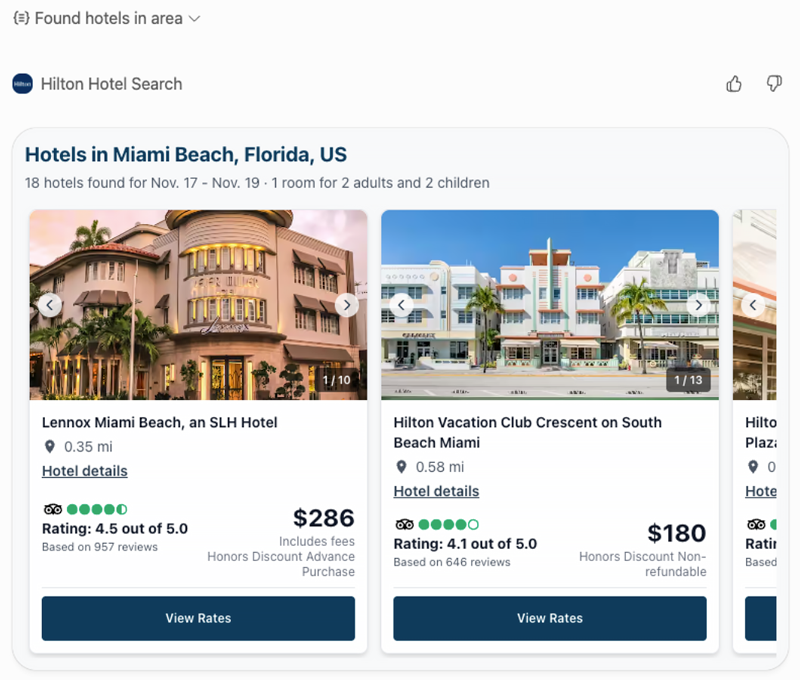
At Mirai, we believe what users truly want is to interact with your hotel using natural language and without leaving ChatGPT. Whether in writing or simply by speaking, as OpenAI recently highlighted during its GPT6-Astra presentation, where it noted that voice will replace the keyboard in how we make decisions and operate. The real transformation goes far beyond porting a UX into ChatGPT. The major shift introduced by assistants is precisely that users no longer need to learn how to navigate a new interface: they can simply express what they need. For example:
“I want to go to Madrid next weekend with my wife and two children. I’m looking for a room with breakfast and I prefer a cancelable rate.”
From there, the assistant should be able to interpret the request and directly use the hotel’s direct channel capabilities: check availability and prices, filter suitable options, compare rooms and rates, explain their differences, and proceed right through to completing the booking.
Voice makes this need even more apparent. How does a user interact by voice with a plugin whose value relies on photos, buttons, and visual elements they cannot see? In that environment, the interface disappears, leaving what truly matters: the hotel’s ability to understand natural language requests and execute actions in response.
And this trend extends far beyond voice. We believe natural language is progressively becoming a new interface for operating digital services, whether by typing or speaking. Preparing your direct channel for this shift is strategic: it is not about bringing the website to ChatGPT, but about ensuring that the hotel’s capabilities can be used directly by assistants.
Plugins can become a new gateway for repeat guests
There is another scenario where plugins can make a lot of sense: the relationship with customers who already know the brand and return regularly. For years, hotel chains have used their mobile apps to build a direct and persistent channel with their most loyal guests. A plugin could come to play a similar role within ChatGPT, but with one key difference: the user does not need to learn a new interface, but simply ask for what they need using natural language.
A repeat customer could view their upcoming stays, search for a chain hotel for a new trip, apply their loyalty perks, book, or manage a reservation from the same assistant they use for many other tasks. In this context, the value of the plugin lies less in discovering an unknown brand and more in becoming a new gateway to the direct channel for guests who already have a relationship with it.
First plugins and much left to learn
These first plugins allow us to experiment with this new architecture in real-world scenarios today. However, we do not want to set wrong expectations: the ChatGPT plugin ecosystem is still in its early stages. Its distribution, discovery, and usage are evolving rapidly, and significant unknowns remain regarding how this market will ultimately operate.
One of these is discovery itself. It seems unreasonable to imagine a future where a traveller must know about and pre-install plugins for hundreds or thousands of hotels just to interact with them. The big question is how assistants will evolve to automatically discover and select the most suitable sources of knowledge and capabilities for each request.
This brings up a second, particularly interesting question: we do not yet know whether plugins will play a role solely in the lower funnel —when the user already knows what they want and it’s time to check availability, book, or carry out an action— or whether they will also form part of the inspiration, discovery, and recommendation phase itself. By providing structured, up-to-date, and directly actionable information, they possess characteristics that make them a potentially valuable source for this phase as well. But as of today, the rules of the game are not yet defined.
Therefore, we do not expect these first plugins to immediately become a new volume channel for hotels. Their current value is, to a large extent, latent: experimenting, learning, and preparing ourselves. Understanding how users interact, which capabilities they use, what level of delegation they accept, how discovery mechanisms evolve, and what the direct channel needs to compete in this new environment.
Ultimately, it is about being prepared when the race truly begins. Because we believe it will start, and probably not take very long.
Although our intention is to progressively extend this capability to our clients, for the moment deployments will be limited until we gain relevant insights, but we wanted to share with you that we are already working on it.
Interested in learning more? Contact your Account Manager for more information.