En español, en français, em português.
Artificial intelligence is no longer a futuristic promise. It has become an operational reality that is already reshaping hotel distribution. Yet, despite the growing excitement around AI, most hotels still face the same fundamental question: how can AI be turned into a real, sustainable competitive advantage aligned with the business? And, perhaps even more importantly: where should I start?
By now, it is clear that AI is not a standalone product or another “plugin.” It is a layer of intelligence that only creates value when it is built on a solid architecture, powered by reliable and structured data, and deeply integrated with the hotel’s core systems.
A pragmatic and business-driven view of AI
The biggest risk in today’s rush to adopt AI is a fragmented approach: disconnected chatbots, inconsistent answers across channels, duplicated content, and assistants that sound intelligent but are unable to perform real actions.
AI only delivers value when it:
- Is based on a single source of truth.
- Understands the hotel’s business context.
- Can act, not just respond.
- Integrates naturally into existing workflows.
This is why, at Mirai, we believe AI adoption is not about replacing traditional channels, but about evolving the direct distribution ecosystem as a whole.
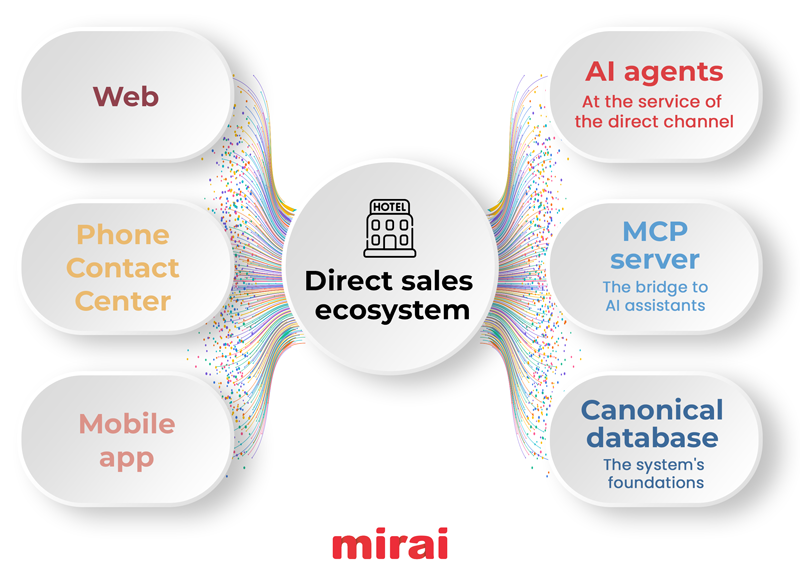
Reinventing the direct distribution ecosystem
The three traditional pillars of direct distribution will continue to play a key role in the years ahead, although their relative importance will shift as AI becomes more prevalent.
1. Website
The primary channel for inspiration and booking. It will remain essential, but it will increasingly share prominence with conversational interfaces such as WhatsApp, ChatGPT, or Gemini.
2. Phone / Contact Center
Human support for complex questions, high-value bookings, and critical moments of decision. This channel will undergo a profound transformation driven by AI, thanks to instant access to reliable, contextual information and the rise of AI-powered voice assistants.
3. Mobile App
A key touchpoint for pre-arrival engagement, in-stay experience, and loyalty: check-in, services, upgrades, and direct communication with the guest.
AI does not eliminate these channels. Instead, it expands the ecosystem with three new strategic components.
4. AI Agents serving the direct channel
AI agents enable hotels to offer conversational interfaces across multiple languages and formats: web chatbots, WhatsApp, Instagram, SMS, and even voice.
These agents coexist with the website and the contact center, but they also open entirely new interaction opportunities, particularly in high-adoption channels that sit far from the traditional web experience, such as WhatsApp.
At Mirai, this component takes shape through Sarai, our conversational agent solution. Sarai answers guest questions, generates quotes, integrates loyalty programs, and can even complete full reservations without forcing the user to leave the conversation or be redirected to the website—while always ensuring full consistency in content, pricing, and conditions with a traditional web booking.
5. MCP Server: the bridge to AI assistants
One of the most strategic components of the new ecosystem is the MCP Server (Model Context Protocol). It acts as a bridge between the hotel and major AI assistants such as ChatGPT or Gemini, as well as the thousands of native AI applications that will emerge in the coming years.
Its role is threefold, and this is how we have approached and implemented the MCP server at Mirai.
- MCP provides structured and reliable information to AI assistants as preferred context, with the goal of increasing the hotel’s presence in the answers these assistants deliver to users. In practice, MCP can become a powerful complement to AI-focused SEO/GEO—not through traditional algorithmic optimization, but by enabling the hotel to become a direct, trusted, and executable source for AI assistants. MCP does not replace SEO or GEO; it introduces a new form of visibility. The challenge is no longer about links, rankings, or citations, but about becoming the source that assistants choose to consult. The goal, however, remains the same: influencing what assistants show to users.
MCP does not guarantee visibility in AI assistants, but it prepares the hotel to be discoverable and actionable as these channels mature.
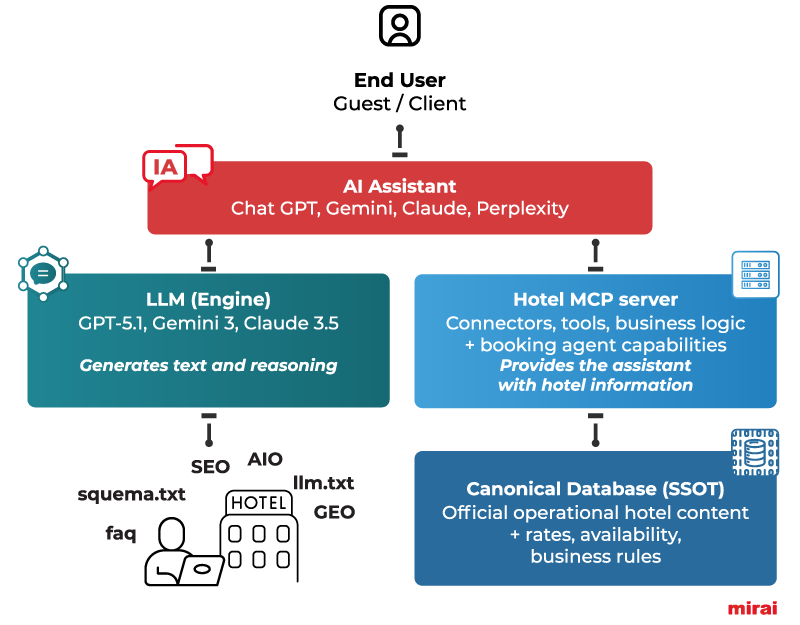
- MCP enables AI assistants to become truly agentic, meaning they do not simply answer questions, but can execute real business actions, such as completing hotel reservations.
For an assistant to offer bookings in a reliable and consistent way, the MCP server must have access to the hotel’s business rules, rates, offers, availability, and loyalty program logic. In practice, this means that AI assistants must operate under the exact same commercial conditions as the hotel’s direct booking engine.
This is a critical point: AI assistants should not be treated as an independent channel with simplified rules or disconnected pricing. If the goal is to allow guests to book through conversational interfaces, whether via ChatGPT, Gemini, or proprietary agents, the underlying system must always be the same booking engine, simply exposed through a different interface.
In this context, MCP acts as the orchestration layer that makes agentic commerce possible, securely connecting AI assistants to the hotel’s core commercial logic, within a framework of permissions, control, and traceability defined by the hotel itself.
As new agentic commerce frameworks begin to emerge — such as Google’s recently announced Universal Commerce Protocol (UCP), this separation of responsibilities becomes even more relevant. UCP should not be understood as another assistant, but as a commerce runtime: a standardized environment where discovery, decision and transaction happen inside a single ecosystem.
In this model, merchants do not control the booking flow or the user experience. Those are defined by the platform. What merchants do control — and must provide — are their agentic capabilities: availability, pricing, rules, and the ability to execute transactions reliably.
This is precisely where a layer like MCP becomes critical. Whether the flow is merchant-led (as with assistants like ChatGPT or proprietary agents) or platform-led (as with UCP), hotels need a single, well-defined way to expose their business logic and transactional capabilities. MCP allows hotels to do this once, and remain compatible with multiple assistants and commerce runtimes without rebuilding their core systems each time.
Under this approach, hotels do not integrate separately with each new platform or assistant. Instead, they expose their data and transactional capabilities once, allowing different AI ecosystems to consume and orchestrate them according to their own frameworks—without sacrificing control, consistency, or ownership of the direct channel.
- Creating applications in AI marketplaces, such as the one recently launched by ChatGPT. Conceptually similar to having an app in the Apple or Android app stores, hotels will be able to “exist” inside AI assistants.
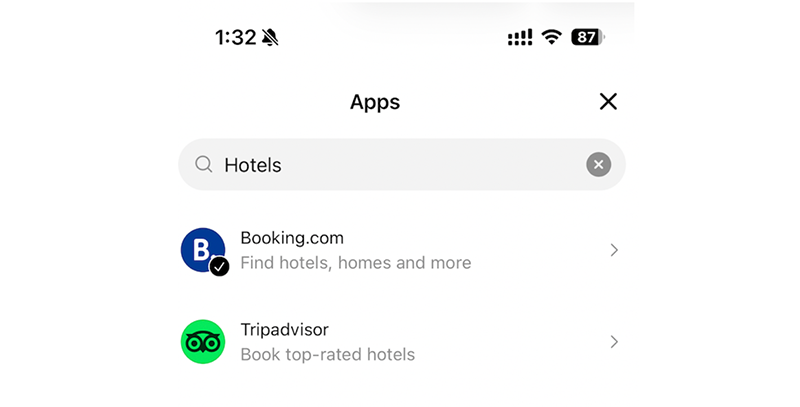
In this context, MCP is the mechanism that exposes business capabilities to these apps in order to:
– Avoid one-off bilateral integrations.
– Be present where users are already making decisions.
– Compete on equal technological footing with OTAs and major players.

6. The canonical database: the foundation of the entire system
Neither AI agents nor the MCP server have real value without access to a canonical, master database that is structured and ready for AI consumption. This is arguably the hotel industry’s biggest Achilles’ heel.
In an environment increasingly dominated by AI assistants, hotels that fail to provide structured, actionable data simply become invisible. Without high-quality structured data, there can be no accurate answers.
Ironically, OTAs already possess these data structures and occupy a space that naturally belongs to hotels. This is not a minor issue—it is the true starting point for many organizations.
This ecosystem cannot be built overnight. It must be deployed in phases, starting with the canonical database.
To create this foundation, the website can no longer be the central repository of knowledge. The challenge lies in consolidating hotel information that is spread across multiple tools—and, in many cases, across teams and individuals. The website will remain fundamental; what changes is where knowledge lives, so that all channels deliver consistent answers.
At Mirai, we address this challenge through Intelligence, a textual knowledge base where hotels can store information without predefined formats. From there, Mirai structures, contextualizes, and makes this knowledge scalable and accessible to AI assistants, ensuring a single source of truth.
A unified ecosystem, not isolated tools
Approaching AI by simply adding more disconnected technologies is a mistake. The real solution lies in orchestrating a coherent direct distribution ecosystem, where each component reinforces the others and the hotel delivers a consistent response regardless of the channel.
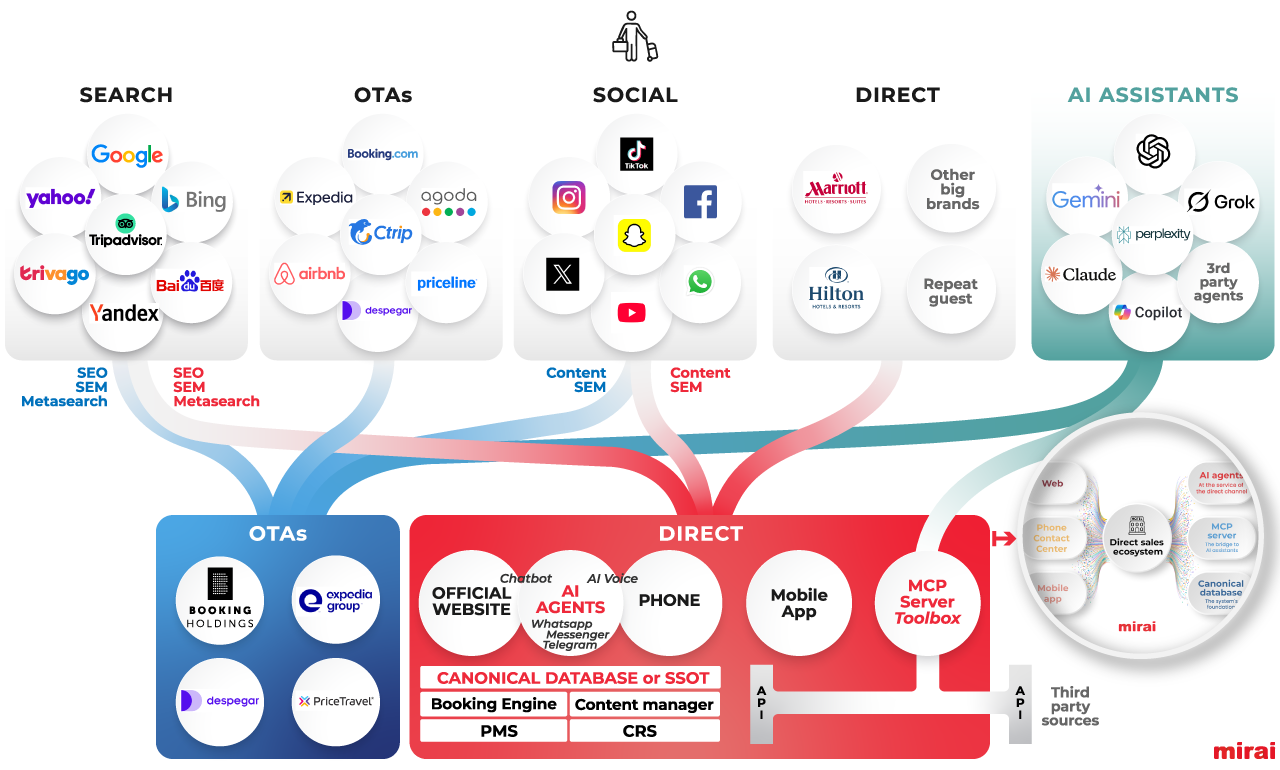
Compared to fragmented models built on multiple vendors, complex integrations, and duplicated content, AI enables the creation of a native, intelligent, and unified ecosystem.
Artificial intelligence will mark a turning point for the hotel industry. In this new landscape, hotels will not compete on who has the best chatbot, but on who has built the most coherent ecosystem—deeply connected to the business and ready to be consumed by AI.
That is, at least, our vision at Mirai, and how we have designed and implemented it in service of our clients.