En español, en français, em português.
In the first part we analysed the difference between PDP and OBP: the “how and the why” of connectivity. Today we are going one step further: we will see “the what and the where”. Here you will discover how your pricing architecture decides your supplements, your ability to react to demand and why controlling your increments is key to maximising your revenue.
The 3 levels: who is in charge of your prices?
Not all hotels “move” their prices in the same way. Depending on your technology, you will be at one level of agility or another. Identify where you are:
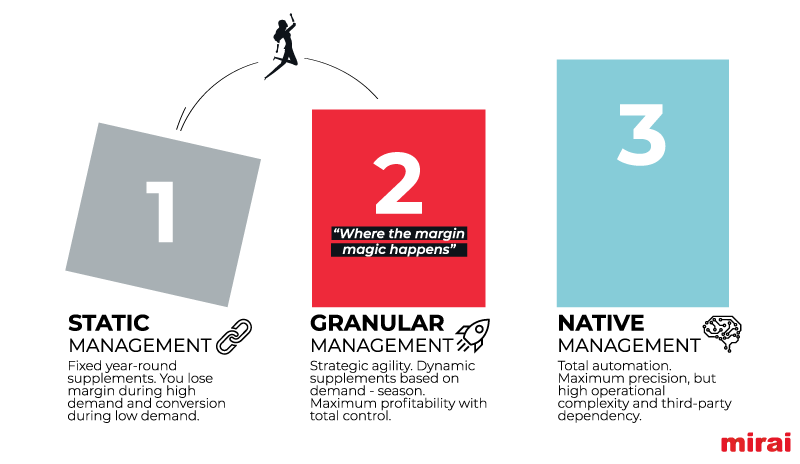
Level 1: the “same old supplement” (Static management)
This is the most basic model and the one used by most hotels: a base price per rate and a fixed rule, generally linear, for the rest of the occupancies.
- Where it happens: normally in the standard configuration of the channel manager, PMS or directly on the channel.
- How it works: “Triple = Base (Double price) + €30”. The supplement is identical in August (high demand) and in November (low demand).
- The risk: it is blind to demand.
– In high demand: you are too cheap → you lose ADR.
– In low demand: you are too expensive → it slows down conversion.
- The symptom: to escape this rigidity, the hotelier ends up creating duplicate rates (“Triple Summer”, “Children’s Promo”) as a solution to what the system does not do on its own.
Here, you do not decide your profitability: you decide it in advance and hope that demand behaves as you assumed.
Level 2: the “smart adjustment” (Granular management) – where additional profits are captured
This is where the real competitive advantage materialises. If your technology allows you to adapt to demand, you start beating the OTAs in technical advantage on your direct channel.
- Where it happens: in an advanced booking engine acting as a strategic corrector or in a PMS/channel manager with dynamic rules.
- How it works: you work with dynamic increments by understanding the context: “The child costs €10 in low season to stimulate family demand, but €50 in high season to maximise revenue”.
- The key advantage: you are surgical. Your direct channel reacts to demand with an agility that the OTA (generally anchored in Level 1 by operational design and scale) cannot match.
- The result: your website captures additional margin. Better conversion and a more coherent final price for the customer.
What is truly disruptive about this level is technological independence. Intelligence moves to the booking engine, which acts as a final strategic corrector and allows for the application of complex and granular pricing strategies without depending on the rigidity of the PMS or the channel manager.
This is the sweet spot of modern revenue: enough sophistication to capture real margin, without the extreme operational complexity of Level 3.
Level 3: the “autopilot” (Native Management)
This is the theoretically perfect scenario. The Revenue Management System (RMS) dictates the exact and final price of each occupancy based on predictive algorithms and/or advanced rules.
- Where it happens: the logic resides 100% in the RMS and is transmitted via pure OBP… if all technology providers allow it.
- What is intended: the RMS calculates exactly how much each occupancy should be worth to the cent.
- The realistic burden: it is an “all or nothing” model. It requires exhaustive mapping of all occupancies.
- The challenge: it involves high maintenance complexity. If you do not exhaustively map all inventory across the entire technological ecosystem (RMS-PMS-channel manager), the RMS cannot “push” the right price for every moment. It is the way forward, but it also requires absolute data integrity to avoid sales errors.
- The reality: for many hotels, Level 3 is the “theoretical ideal”, but Level 2 is the “sweet spot” of real profitability. It is more powerful, but it only works when the entire technological chain is ready to sustain it without friction.
The “Technological Disparity” strategy, or how to earn margin without breaking parity
We usually associate “disparity” with breaking base price parity (being cheaper on the base). But, what if your direct channel uses a more advanced pricing architecture than that of the OTAs, allowing you to compete in price and margin without touching the base rate?
Large OTAs, due to their massive volume, tend to operate with more standardised and linear rules (Level 1). If you manage your direct channel with granular rules (Level 2), you create a technical disparity in your favour:
- In low demand (Goal: volume): your booking engine adjusts the supplement downwards automatically. You are more competitive than the OTA -which keeps its supplement fixed and high- without needing to break base price parity. You win on price.
- In high demand (Goal: profitability): your booking engine raises the supplement to capture all the margin that the OTA would let slip away due to its rigidity.
What would be the risk? That your website ends up more expensive than the OTA when comparing the same product.
The solution? Drastically reduce comparability with the OTAs. Some possibilities could be the following:
- Opacity via loyalty: this is the crown jewel. Apply your Level 2 increments within your Loyalty Club to optimise the discount margin. Being a closed environment of private rates, the OTA does not track the disparity, respecting public parity and protecting your visibility, while allowing you to offer an attractive final price for the Club member, but much more profitable for you by recovering margin via supplements (a benefit that goes far beyond net ADR).
If your priority is to maintain maximum exposure on the OTAs without touching availability, minimum stays or other levers… the Loyalty Club is your master lever. It allows you to apply Level 2 intelligence opaquely: maintaining public parity to comply with the OTA, but optimising the real margin of each booking with your members.
Beyond the Loyalty Club, there are additional levers that can reinforce this strategy in times of high demand:
- Selective closing of room types or basic rates on OTAs.
- Minimum stay for multiple occupancies.
- Cancellation or lead time restrictions.
These levers do not replace Level 2: they complement it in a timely manner and must be used with surgical precision.
Combining levers could help. Use the Club to protect the daily margin, and use direct sales protection levers such as closing for more premium room types, minimum nights (minLOS) to filter higher-value demand towards your direct channel, or other levers.
“Margin arbitrage”: how to earn more by selling for less
Let’s look at a real example of how technology (Level 2) beats inertia (Level 1).
Scenario: mid-low season date where you need volume, but the OTA keeps its supplements fixed.
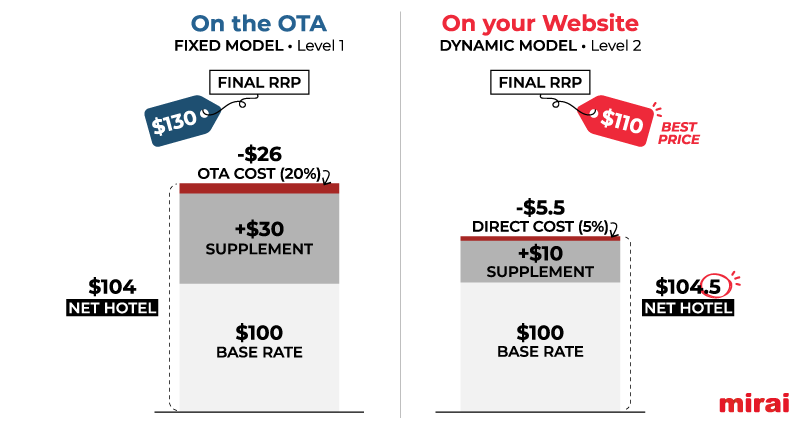
A) On the OTA (Fixed model – Level 1)
Applies its static linear supplement of +€30 for triple occupancy.
- Base Price: €100
- Final RRP: €130
- OTA cost (20%): -€26
- Net for the hotel: €104.00
B) On your Website (Dynamic model – Level 2)
You adjust the supplement to +€10 due to demand strategy for triple occupancy.
- Base Price: €100
- Final RRP: €110 (Much more attractive for the customer: -€20)
- Direct cost (approx 5%): -€5.50
- Net for the hotel: €104.50
Arbitrage result: thanks to a more efficient cost structure, your website offers an irresistible price (€20 cheaper for the customer), captures the sale ahead of the OTA and your net income is higher (+€0.50), in addition to gaining the customer’s data.
By doing it through a technical disparity (modifying the supplement and not the base rate), it is a much more coherent strategy, difficult to track and justifies the investment in technology that allows for this granularity.
The magic of arbitrage is here: by moving the increment in the engine (Level 2) and not in the channel manager (Level 1), you not only win the direct sale, but you turn the channel’s rigidity into clean margin.
Self-diagnosis: is your technology limiting your revenue?
Does this happen at your hotel?
- You need to constantly duplicate rates to make up for the lack of flexibility.
- The supplement never fits: sometimes expensive, sometimes cheap…
- Channels show different prices from those configured.
- Your team spends hours checking parity.
- Changing a supplement involves touching several systems (RMS, PMS, channel manager, booking engine).
- Your supplements are the same in August and November.
- A 14-year-old pays the same as a 4-year-old.
- The channel manager or the OTA are determining your final price, not you.
If you have ticked several boxes, the question is not whether your team is doing revenue well, but whether your technology allows them to do it well.
Take control of your increments
Modern revenue is no longer just about moving prices. It is about moving margins with the same speed at which demand changes. It is the only place where direct sales can compete today with real technical autonomy.
The future is not just a dynamic base price. It is a dynamic supplement, granular and controlled by the hotel.
Very soon, at Mirai, we will launch a native Increment Module on OBP that responds exactly to this need.