En español, en français, em português.
This scenario will sound familiar: there was a time when many hoteliers believed that having a website with a booking engine meant having direct sales. A nice-looking website was designed, a booking engine was connected with a big “Book Now” button… and then it was just a matter of waiting. The “if you build it, they will come” approach worked for Kevin Costner, but I don’t think it’s a spoiler anymore if I tell you what happened in the hotel industry: bookings didn’t come on their own.

We had to learn—sometimes the hard way—that for a direct website to generate sales, you first have to get the distribution right: work on pricing and parity, invest in visibility, and give customers reasons to book there rather than elsewhere. The website is a tool, not the outcome.
Well then, B2B is the exact same story.
What direct B2B is and where it often falls short
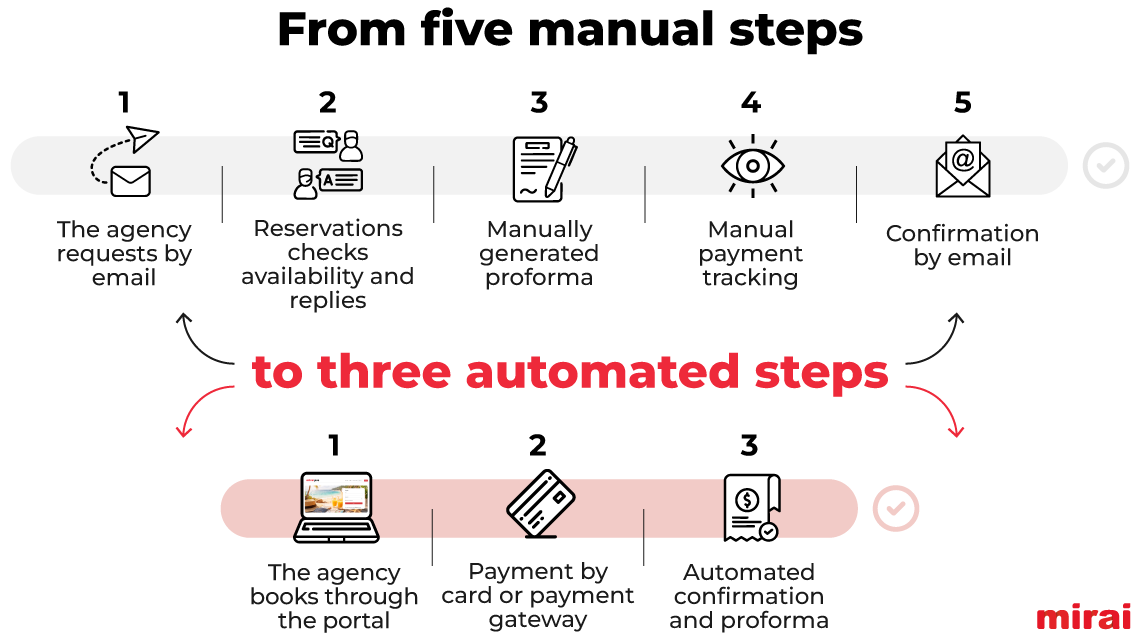
When we talk about direct B2B, we’re referring to the hotel’s own channel for reaching industry professionals: retail agencies, wholesalers, small tour operators or companies—without a bed bank in between. It is, by far, the least developed channel in most chains. It still operates via email, phone calls, Excel spreadsheets with negotiated rates, and pro forma invoices that someone creates one by one.
That is why, when a hotel chain finally decides to launch a platform for that channel, it is easy to fall into the same trap as with the website: thinking that the work ends on launch day. But it doesn’t. Having a B2B portal doesn’t mean having a channel that sells. It means having the tool to build one.
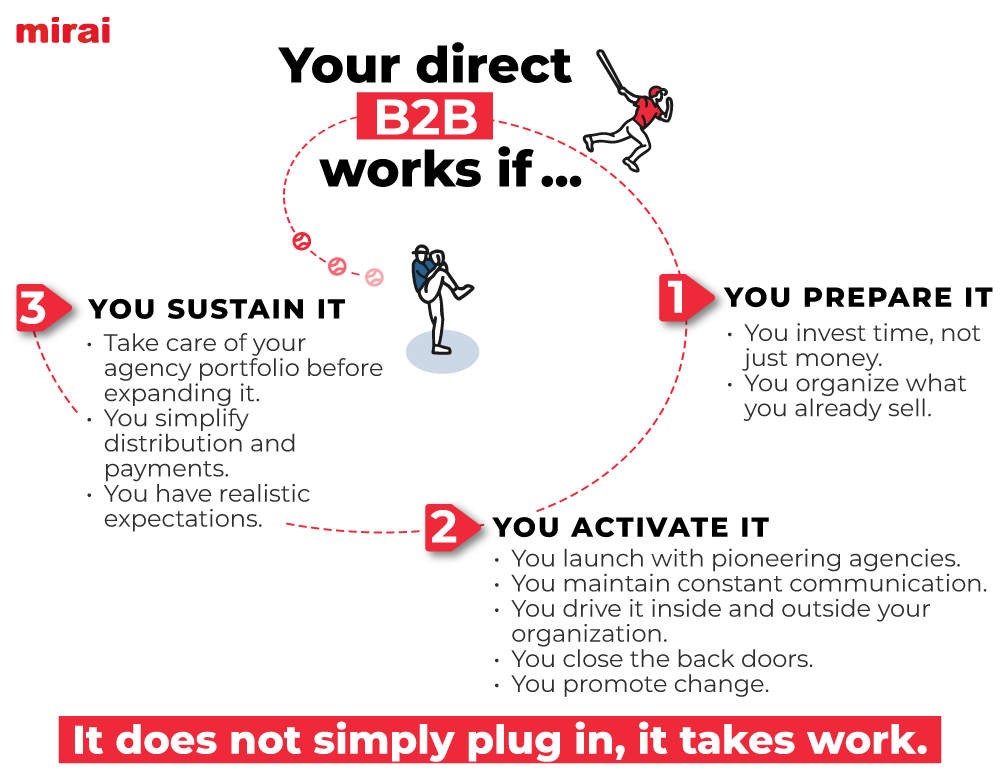
The investment that really makes a difference is not limited to what you invest in the platform, but rather the time and attention you dedicate to it.
Organize what you already sell
An in-house B2B channel is not just a source of new business. Above all, it helps to organize the business you already have with wholesale and retail agencies, and to lighten the daily operational workload it generates. That’s why the starting question is not just how much more you are going to sell, but which processes are pain points for you right now: the back-and-forth emails that take three rounds to close a booking, the manual pro forma invoices, the payment that nobody knows if it has been received. That’s where your return lies.
Push the channel internally and externally
A new channel needs someone to give it a push—in two directions.
Internally, the organization needs to know which part of the business will be managed through this channel. If sales, reservations, and management are not aligned, everyone will continue doing things as usual, and the channel will be left to fend for itself.
Externally, you have to make it visible. When you launch a direct website, no one disputes (well, maybe some do…) that you need to invest in digital marketing so people can find you. It’s the same with B2B: you have to promote the platform among the agencies, corporate clients, or wholesalers you want to work with. If they don’t adopt it, it doesn’t matter how good it is.
And the push doesn’t end on launch day. Communication with agencies must be constant: addressing questions and issues agilely and informing them about offers, campaigns, and news. An agency that gets stuck on its first booking and finds no answer will go back to email; one that feels well taken care of will stay.
At first, rely on the early-adopter agencies—the first ones to register, make reservations, and give you feedback. They are your best selling point to the rest, so take good care of them and reward them, each in their own measure: better commissions, preferential terms, or more personalized service.
And quality is better than quantity. Thousands of registered agencies look great in a presentation, but they don’t guarantee more bookings than a small, well-maintained base. First, find out what your agencies need, what makes them book, and what holds them back. Then, scale up.
Close the backdoors (without slamming them shut)
This is probably the most uncomfortable point—and also the most decisive one. If an agency can keep booking as usual, by email or phone with your reservations team, would it want to change its routine?
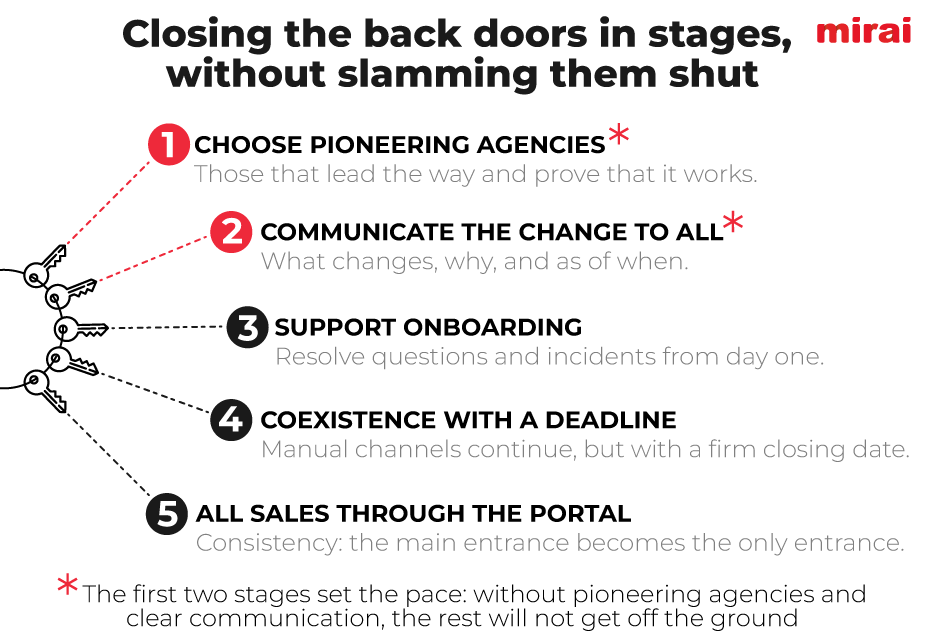
For the platform to take off, you have to divert the sales that currently come in through manual channels to it. That includes email or phone agreements with retail agencies, but also manual contracts and static feeds with wholesalers or small tour operators, which place a huge operational burden on you.
It’s not about cutting things off overnight—especially not with key agencies that bring in volume. It’s about proposing a progressive and well-communicated transition: explaining the change, guiding the onboarding process, giving a reasonable timeframe, and once that deadline arrives, following through. If you keep all backdoors open indefinitely, the main door will never be used.
It’s work, yes. Thinking that you are going to launch and start receiving bookings out of nowhere is a mistake. But the payoff is worth it: all the time and operational cost involved in back-and-forth asynchronous communication, generating pro forma invoices, or tracking payments cease to exist when the platform simplifies and automates the process.
Give the agency a reason to change
Asking someone to change the way they work is much more effective if they stand to gain from it. That’s why, just as you do with your direct B2C channel, offering exclusive terms through your B2B channel works very well: campaigns and offers that are available only there.
And keep in mind, not everything has to be a discount off the price. Think about what really motivates a sales agent: a higher commission, or more competitive net rates that leave them a higher markup margin. When the benefit is for them, the incentive to sell more is immediate. And in the process, you protect your retail price.
Simple scales up; complicated doesn’t
Having a platform that allows you to diversify, create different conditions, and tailor them to each type of customer is essential. But it’s just as essential to simplify your distribution. And this applies to B2C, B2B, tour operating, and everything else: a simple distribution system is a scalable one. One full of exceptions, special cases, and rules that only one person on the team understands is not.
This is most evident when it comes to payments. Nowadays, paying by card or through a payment gateway is standard practice in any industry. Try to eliminate payment methods that complicate your life and that, deep down, only allow you to reach a small percentage of your business. Apply a little Pareto principle: cover 80% of cases effectively with the simplest solutions.
If you think bank transfers are essential for your business, go ahead—you can offer them. But be clear about what that entails afterward: tracking collections, reconciliation, applying payments… There is no need to go overboard with options, because in the end, the simplest solution is the one that works best.
Manage expectations
Moving from a completely manual model to one that automates a good part of the process is already a huge leap. Expecting it to also resolve, from day one, every edge case that no current solution covers is a recipe for frustration. If there is a critical component that the platform doesn’t cover, consider making a small additional investment, but don’t give up on automating 80% just because the remaining 20% is missing.
Where to start
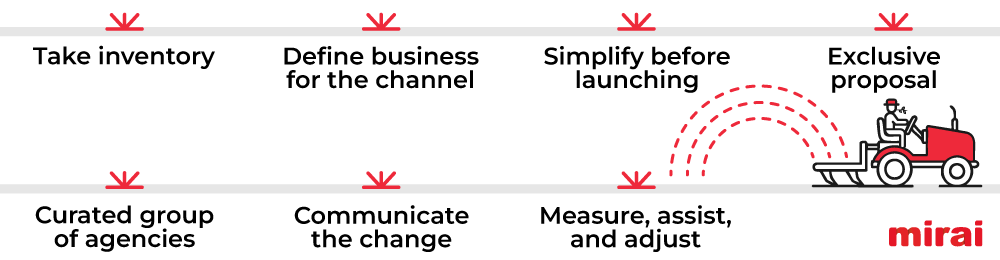
If you have made it this far thinking “okay, my B2B is a mess—now what?”, here are the steps:
- Take stock of how agencies book with you today: through which channels, at what volume, and which processes cause you the most trouble.
- Decide which business you want to move to the channel and align sales, reservations, and management.
- Simplify before launching: terms, rates, and payment methods.
- Design an exclusive proposal for the channel: better commission, net rates with higher margins, or proprietary campaigns.
- Start with a small group of early-adopter agencies and nurture them.
- Communicate the change to the rest and set a deadline to close manual channels.
- Measure performance, address questions and issues, and adjust before scaling up.
None of these steps is complicated, but they all require the same thing: a clear strategy and time to carry it out. A direct B2B channel grows at the pace at which you devote attention to it; the better you know what you want to achieve with it and the more you work on it, the sooner it will start delivering results. Because your direct B2B, just like your website back in the day, isn’t something you just plug in: it takes work. And when you put in the work, it works.