En español, en francés, en portugués.
With the addition of multi-room bookings, Sarai is taking another step forward in the evolution of direct hotel bookings. Our AI assistant and conversational booking engine now allows users to check availability, prices, and options for two or more rooms within a natural, simple experience tailored to the customer’s language.
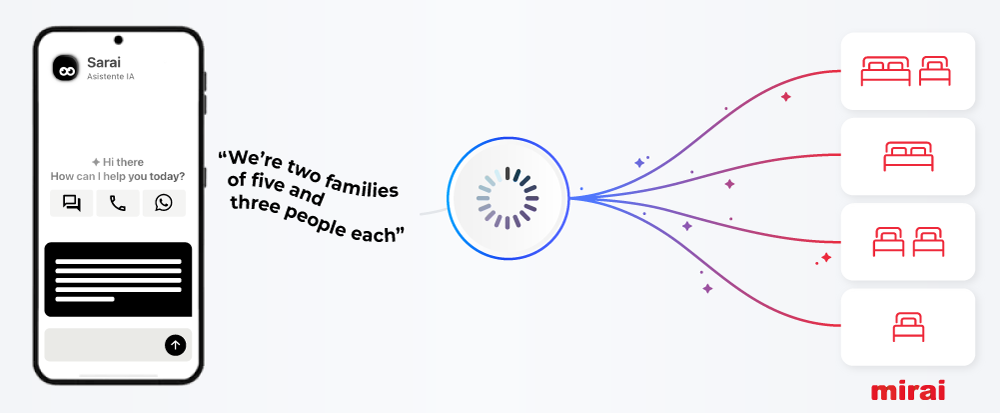
This feature is available on all channels where Sarai operates: webchat, WhatsApp, email, Instagram and phone. It also supports ChatGPT via Apps and Claude via MCP.
This step forward is particularly significant because multi-room functionality is not a secondary use case. It is one of the most valuable features for hotels and, until now, one of the most challenging to implement effectively in conversational experiences.
Multi-room: only 9% of bookings, but nearly 20% of revenue
The data clearly shows the importance of these reservations. So far in 2026, multi-room reservations on the web booking engine account for 9.07% of total bookings, representing 10.86% on desktop and 7.08% on mobile.
But their impact on business is much greater than their share in terms of volume: these bookings generate 18.45% of room nights and 18.44% of revenue. In other words, multi-room accounts for nearly twice as much in economic value as they do in number of bookings.
| Number of rooms | % bookings | % room nights | % revenue |
| 1 room | 90.93 % | 81.55 % | 81.56 % |
| 2 or more rooms | 9.07 % | 18.45 % | 18.44 % |
| • 2 rooms | 7.04 % | 12.78 % | 12.90 % |
| • 3 or more rooms | 2.03 % | 5.67 % | 5.54 % |
| Total | 100.00 % | 100.00 % | 100.00 % |
The pattern observed in Sarai is very similar. In an analysis of conversations from the last 30 days, around 7.03% of availability queries included requests for two or more rooms.
This confirms that there is also demand for multi-room solutions in the conversational channel. And it doesn’t just exist: it arises very naturally. Customers don’t always want to fill out a complex form. Often, they simply state their need:
“I need two rooms for a family with children”
“We are two couples and we want separate rooms”
“We’re looking for three rooms for a group of friends”
“Two families traveling together — we’d like to check availability”
In a conversational environment, requests like these fit in naturally. Sarai understands the situation, guides the user, and makes it possible to proceed directly to a reservation even in more complex scenarios.
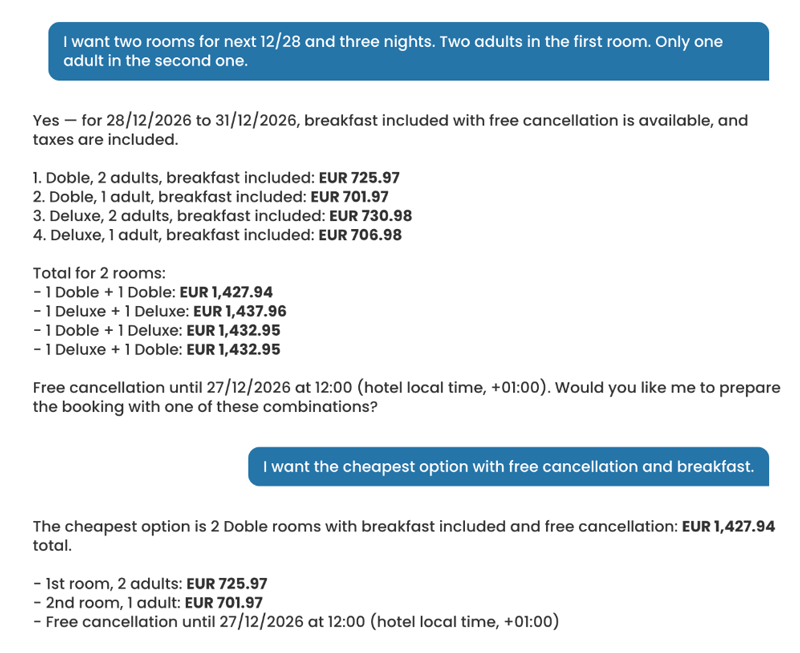
The strategic importance becomes even clearer when analyzing its economic impact:
Although most multi-room bookings are for two rooms, bookings of three or more rooms carry disproportionate economic weight. They account for only 2.03% of total bookings, but generate 5.54% of revenue.
That is why having strong multi-room capabilities is no small matter. It is a direct way of improving the hotel’s ability to capture higher-value demand.
If multi-room was essential for the web engine, it is now a must for conversations too
For years, supporting multi-room reservations in the web booking engine has been a must for any hotel looking to maximize its direct sales. But user behavior is changing.
More and more customers expect to be able to express their needs using natural language, especially on mobile devices, where managing multiple rooms in a traditional form can be cumbersome. While a classic booking engine requires selecting occupancies, adding rooms and navigating through several steps, a conversational experience allows customers to explain their situation exactly as they envision it.
This is where Sarai makes a key difference. It doesn’t just answer questions. It understands scenarios involving multiple rooms, helps users assign people to rooms, and brings the conversational channel closer to a real direct booking experience.
The result is a more natural user experience and a stronger business opportunity for the hotel.
For groups, Sarai turns demand into a lead
The value of multi-room extends beyond reservations for two or three rooms. There is a second, particularly strategic scenario: when a customer requests more rooms than the engine allows to book online.
Typically, from five or six rooms onward, many requests are classified as group bookings. In a traditional web booking engine, this scenario often disrupts the user experience. The customer reaches the system’s limit and is forced to contact the hotel on their own, usually by email or phone.
The problem is clear: the hotel doesn’t know if that customer will eventually get in touch, switch to another channel, or simply abandon the reservation. In a conversational experience, the situation changes completely.
Sarai can naturally explain that the request exceeds the room limit allowed for online booking and, at that very moment, ask for the customer’s contact details to pass the request to the hotel.
In this way, a potential loss becomes a qualified lead.
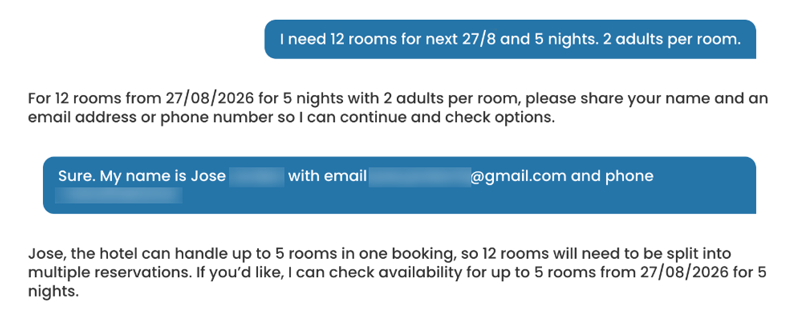
This offers a significant advantage over traditional web booking engines. Instead of letting the customer abandon the process, Sarai collects the necessary information — name, email, phone number, dates, number of rooms and details of the stay — and generates a sales opportunity so the hotel can contact the customer as soon as possible.
This opportunity is reflected in real time on Lobby, our AI infrastructure and conversational assistants dashboard. In addition, the hotel receives an email notification with the customer’s details so it can take immediate action.
Group reservations are particularly important for hotels because of their high potential value. Although they cannot always be closed automatically online, they can be captured, organized and forwarded to the sales team at the exact moment the customer shows purchase intent.
Sarai doesn’t just answer: it converts
With this development, Sarai further widens the gap between itself and other assistants or chatbots in the industry.
Most conversational solutions can provide information, answer frequently asked questions, or redirect users to the traditional booking engine. Sarai goes a step further: it allows users to proceed with direct conversational bookings even in complex, high-value scenarios for the hotel.
The multi-room adaptation shows that the future of hotel booking will not be solely conversational. It will also need to be capable of resolving complex, mobile and higher-economic-impact cases.
Sarai thus strengthens its position as the first conversational hotel booking engine and as a key player in capturing direct demand in the new era of AI assistants.
Sarai, included for Mirai booking engine clients
Sarai is not an added chatbot or an external solution that the hotel has to integrate separately. It is natively connected to the Mirai booking engine to inform, quote, and complete bookings within a natural conversation.
This capability is included, at no additional cost, for Mirai booking engine clients. Where the market offers separate pieces -booking engine on one side, AI on the other-, Mirai offers an integrated end-to-end experience.
If you don’t have it active yet, contact your account manager, who will provide you with all the information you need to activate it.